
 Deutsch
 English
 Français
 Español
 Italiano
 Nederlands
 Português
 Slovenčina
 Hrvatski
 Slovenščina
 Lietuvių
 Eesti
Eesti Български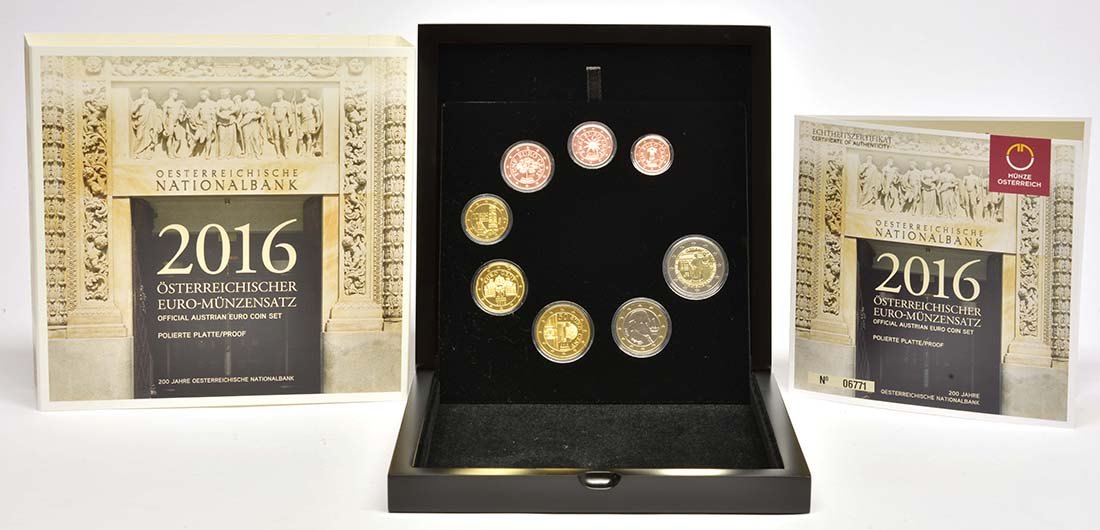
CC 232 2016
Coin set
Proof
Coin set proof
Austria · 200 years Austrian Nationalbank
Mintage10,000
Issue price€79.80
Issue date2 Dec 2015
PackagingCoin set
Edge lettering2 EURO ★★★ × 4, alternating upright/inverted
Market price€60.00
Issue occasion
The coin commemorates the 200th anniversary of the Oesterreichische Nationalbank, founded in 1816. The design depicts its main building, as well as Mercury, the god of trade, and Fortuna with a cornucopia as a symbol of prosperity. A ribbon recalls the red-white-red Austrian flag; the design is completed by the years “1816” and “2016” and the inscription “200 years Oesterreichische Nationalbank”.
The design
The design depicts two gods from Roman mythology shown on the stone relief above the entrance to the main building of the Oesterreichische Nationalbank (OeNB): Mercury on the left, the messenger of the gods and god of merchants and trade; Fortuna on the right, the goddess of fate and prosperity, depicted with a cornucopia. In the background of the coin’s inner disc, the main building of the OeNB extends from the left to the right edge. Along the lower edge of the coin’s inner disc runs a band reminiscent of the red-white-red pattern of the Austrian flag; according to the rules of heraldic design, the vertical hatching symbolises the colour red. The dates “1816” and “2016” to the left of Mercury refer to the year the OeNB was founded and its 200th anniversary. The inscriptions along the edges of the gold-coloured inner disc read “Republik Österreich” and “200 years Oesterreichische Nationalbank”.
The twelve stars of the European flag are depicted on the outer ring of the coin.
The twelve stars of the European flag are depicted on the outer ring of the coin.
Background on the topic
The establishment of the Nationalbank was connected with the financial consequences of the Napoleonic Wars. The Habsburg Monarchy had financed its expenditures to a large extent through paper money. A sharp loss of value and the state bankruptcy of 1811 shook confidence in the currency. Emperor Franz I then established the “Privilegirte Oesterreichische National-Bank”. As a joint-stock company with the privilege of issuing banknotes, it was intended to stabilize the monetary system and limit the currency’s dependence on direct state financing.
With the political reorganization into the Austro-Hungarian Dual Monarchy, the central bank organization also changed. From 1878, the Oesterreichisch-ungarische Bank took over the central bank functions for both halves of the empire. Following the end of the monarchy and the post-war inflation, the Austrian central bank was reorganized in the 1920s. It contributed to the stabilization of the currency and the introduction of the Schilling. After the “Anschluss” of Austria to the German Reich, it was dissolved in 1938; in 1945, it resumed its activities.
Since the beginning of the third stage of Economic and Monetary Union, the Oesterreichische Nationalbank has been part of the European System of Central Banks and the Eurosystem. Monetary policy decisions for the euro area are taken jointly by the Governing Council of the European Central Bank. In Austria, the Nationalbank is involved, among other things, in their implementation, manages foreign exchange reserves, supplies the country with cash, and contributes to the supervision of financial stability and payment systems.
The building depicted on Otto-Wagner-Platz in Vienna was constructed according to plans by the architect Leopold Bauer. It was originally intended for the central bank of the Habsburg Monarchy and was completed during the years of the First World War. Its architectural sculpture connects the institution with trade, monetary affairs, and economic security.
The anniversary presented an occasion for a coin because the history of a central bank is directly connected with banknotes, coins, and confidence in a currency. At the same time, the issue points to the transition from an Austrian central banking tradition to the common European monetary system.
With the political reorganization into the Austro-Hungarian Dual Monarchy, the central bank organization also changed. From 1878, the Oesterreichisch-ungarische Bank took over the central bank functions for both halves of the empire. Following the end of the monarchy and the post-war inflation, the Austrian central bank was reorganized in the 1920s. It contributed to the stabilization of the currency and the introduction of the Schilling. After the “Anschluss” of Austria to the German Reich, it was dissolved in 1938; in 1945, it resumed its activities.
Since the beginning of the third stage of Economic and Monetary Union, the Oesterreichische Nationalbank has been part of the European System of Central Banks and the Eurosystem. Monetary policy decisions for the euro area are taken jointly by the Governing Council of the European Central Bank. In Austria, the Nationalbank is involved, among other things, in their implementation, manages foreign exchange reserves, supplies the country with cash, and contributes to the supervision of financial stability and payment systems.
The building depicted on Otto-Wagner-Platz in Vienna was constructed according to plans by the architect Leopold Bauer. It was originally intended for the central bank of the Habsburg Monarchy and was completed during the years of the First World War. Its architectural sculpture connects the institution with trade, monetary affairs, and economic security.
The anniversary presented an occasion for a coin because the history of a central bank is directly connected with banknotes, coins, and confidence in a currency. At the same time, the issue points to the transition from an Austrian central banking tradition to the common European monetary system.
Interesting Facts
This coin set contains all seven circulating coins from 1 cent to 1 euro as well as this €2 commemorative coin (face value: 3,88 €).