
 Deutsch
 English
 Français
 Español
 Italiano
 Nederlands
 Português
 Slovenčina
 Hrvatski
 Slovenščina
 Lietuvių
 Eesti
Eesti Български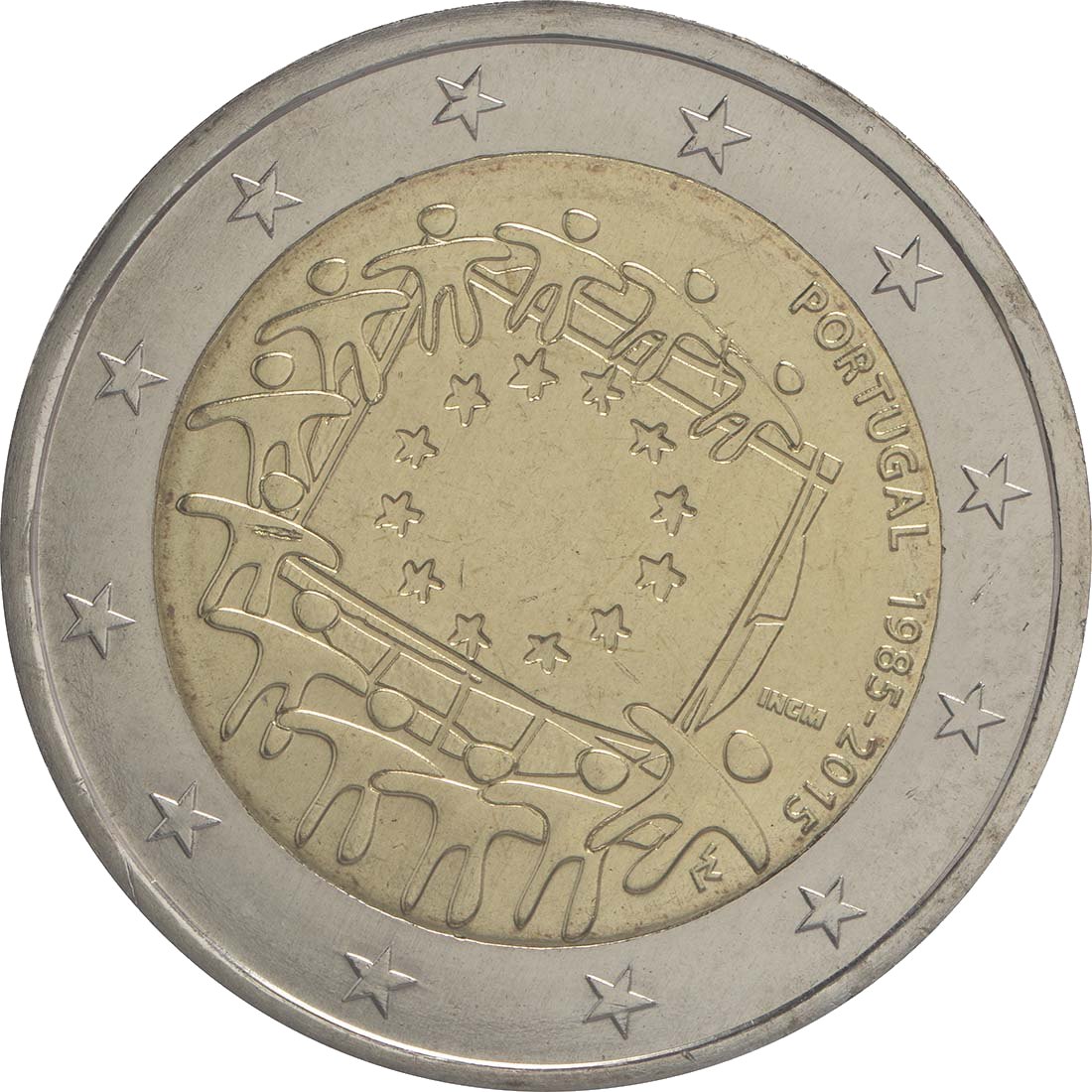
CC 225 2015
2 euro coin
BU Main coin Bank issue
2 Euro BU
Portugal · 30 years of the EU flag
Mintage500,000
Issue date30 Nov 2015
Edge lettering5 Wappenschilde + 7 castles, evenly distributed
Market price€7.50
Issue occasion
The commemorative coin honours the thirtieth anniversary of the EU flag. The design by Georgios Stamatopoulos depicts the EU flag as a unifying symbol for peoples and cultures with shared ideas and ideals. Twelve stars take the form of people and welcome the birth of a new Europe; the design is complemented by the inscription “PORTUGAL” and the years “1985-2015”.
The design
The design depicts the EU flag as a symbol bringing together peoples and cultures with shared ideas and ideals to shape a better future. Twelve stars take the form of people and welcome the birth of a new Europe. At the top right along the coin ring, the issuing country “PORTUGAL” and the years “1985-2015” can be seen. The mint mark “INCM” is located on the right between the flag and the dates. The designer’s initials (Georgios Stamatopoulos) are shown at the bottom right. The twelve stars of the European flag are depicted on the outer coin ring.
Background on the topic
The star flag now known as the EU flag did not originally emerge within the European Communities. The Council of Europe (Europarat), an international organisation founded in 1949 and independent of the European Union (Europäische Union), adopted it as its own emblem in 1955. The aim was to create a symbol that could represent Europe independently of changing political borders and numbers of members.
The circle stands for unity and equality. The number twelve referred neither to the number of member states at the time nor to an intended number of member states. It was understood as the traditional number representing completeness and cohesion. For this reason, the number of stars remained unchanged during the subsequent enlargements of the European organisations. Their arrangement also avoids any hierarchy: no star occupies a prominent position.
In the 1980s, the European Communities sought common symbols that would be more easily recognisable in everyday life than the emblems of their individual institutions. In 1985, the European Council approved the adoption of the star flag. From 1986 onwards, it was used by the Communities; the European Union, founded in 1993, continued to use it. The 2015 anniversary therefore referred to the political adoption of the already older symbol, not to its original design.
For Portugal, this retrospective was linked to an additional historical context. The country joined the European Economic Community (Europäische Wirtschaftsgemeinschaft) together with Spain on 1 January 1986. The accession followed the Carnation Revolution of 1974, the end of the authoritarian dictatorship and the subsequent democratic reorganisation. The introduction of the European flag by the Communities and Portugal’s membership therefore occurred almost simultaneously.
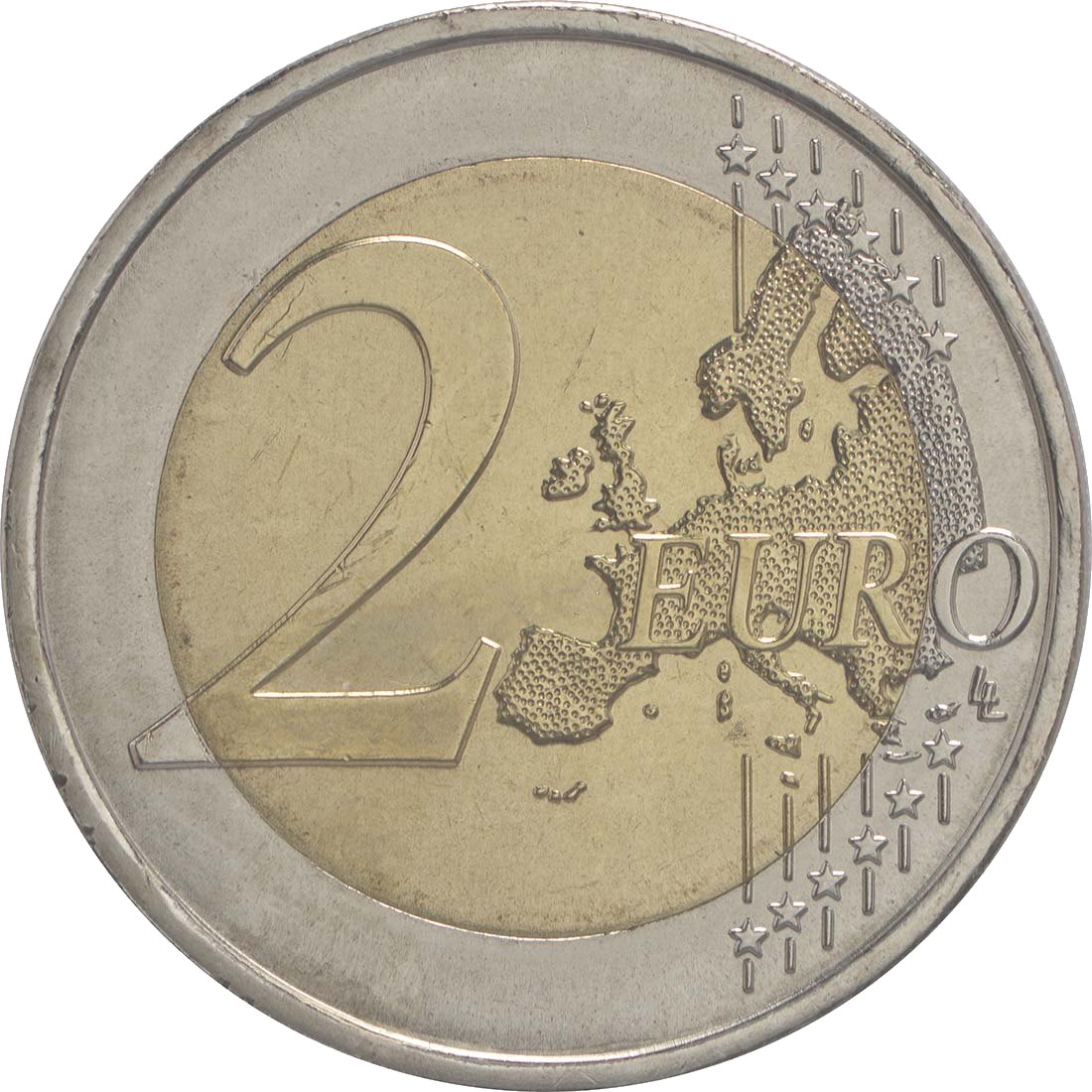
The occasion was suitable for a joint commemorative issue because the flag does not represent a single country or a national event. A uniformly designed coin could thus refer to the common political symbolism of the euro area, while the respective issuing countries remained identifiable on the national side.
The circle stands for unity and equality. The number twelve referred neither to the number of member states at the time nor to an intended number of member states. It was understood as the traditional number representing completeness and cohesion. For this reason, the number of stars remained unchanged during the subsequent enlargements of the European organisations. Their arrangement also avoids any hierarchy: no star occupies a prominent position.
In the 1980s, the European Communities sought common symbols that would be more easily recognisable in everyday life than the emblems of their individual institutions. In 1985, the European Council approved the adoption of the star flag. From 1986 onwards, it was used by the Communities; the European Union, founded in 1993, continued to use it. The 2015 anniversary therefore referred to the political adoption of the already older symbol, not to its original design.
For Portugal, this retrospective was linked to an additional historical context. The country joined the European Economic Community (Europäische Wirtschaftsgemeinschaft) together with Spain on 1 January 1986. The accession followed the Carnation Revolution of 1974, the end of the authoritarian dictatorship and the subsequent democratic reorganisation. The introduction of the European flag by the Communities and Portugal’s membership therefore occurred almost simultaneously.
The occasion was suitable for a joint commemorative issue because the flag does not represent a single country or a national event. A uniformly designed coin could thus refer to the common political symbolism of the euro area, while the respective issuing countries remained identifiable on the national side.
eBay price analysis
For this issue, there is a price history based on actual eBay sales – with median, range and number of sales
View price analysis