
 Deutsch
 English
 Français
 Español
 Italiano
 Nederlands
 Português
 Slovenčina
 Hrvatski
 Slovenščina
 Lietuvių
 Eesti
Eesti Български
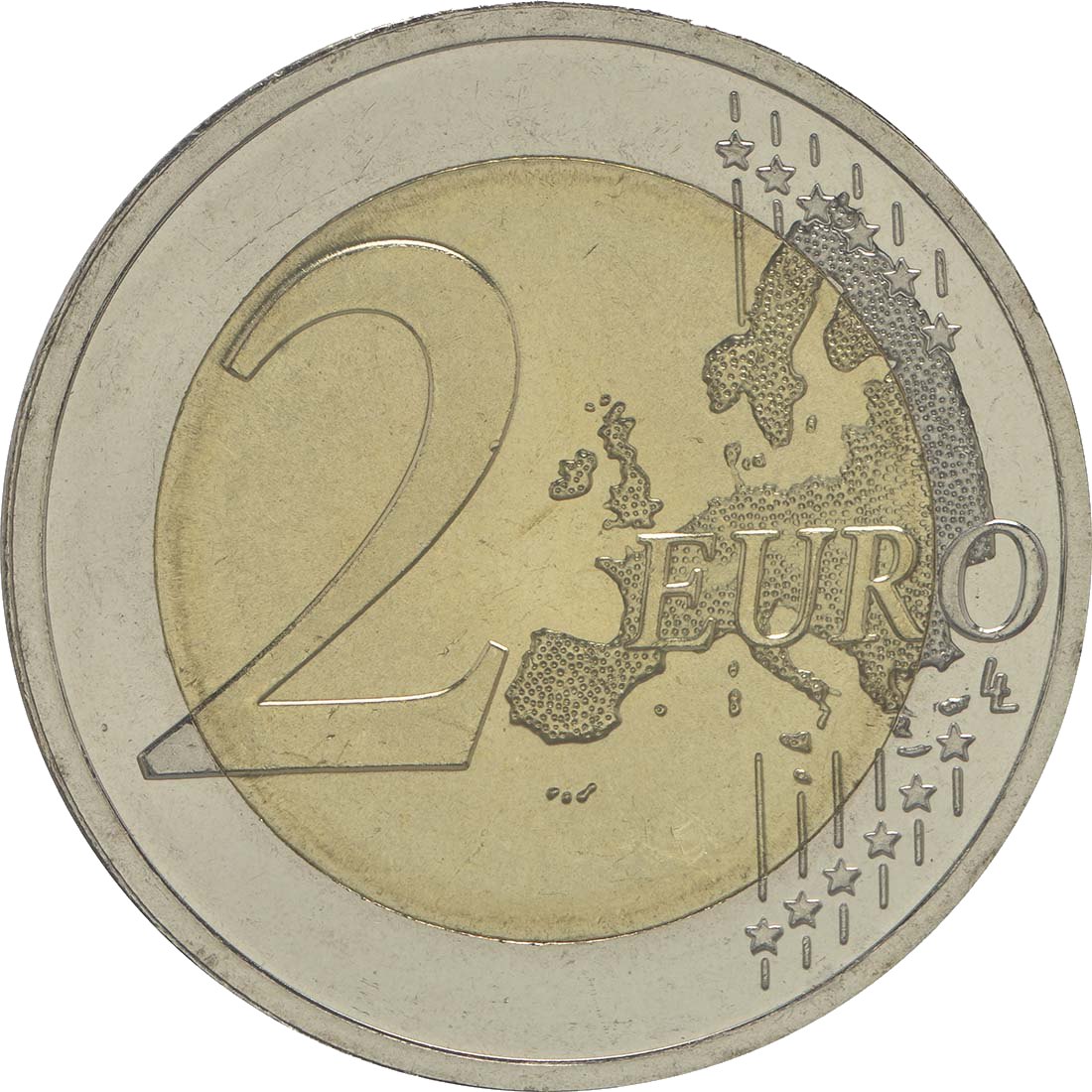
Reverse
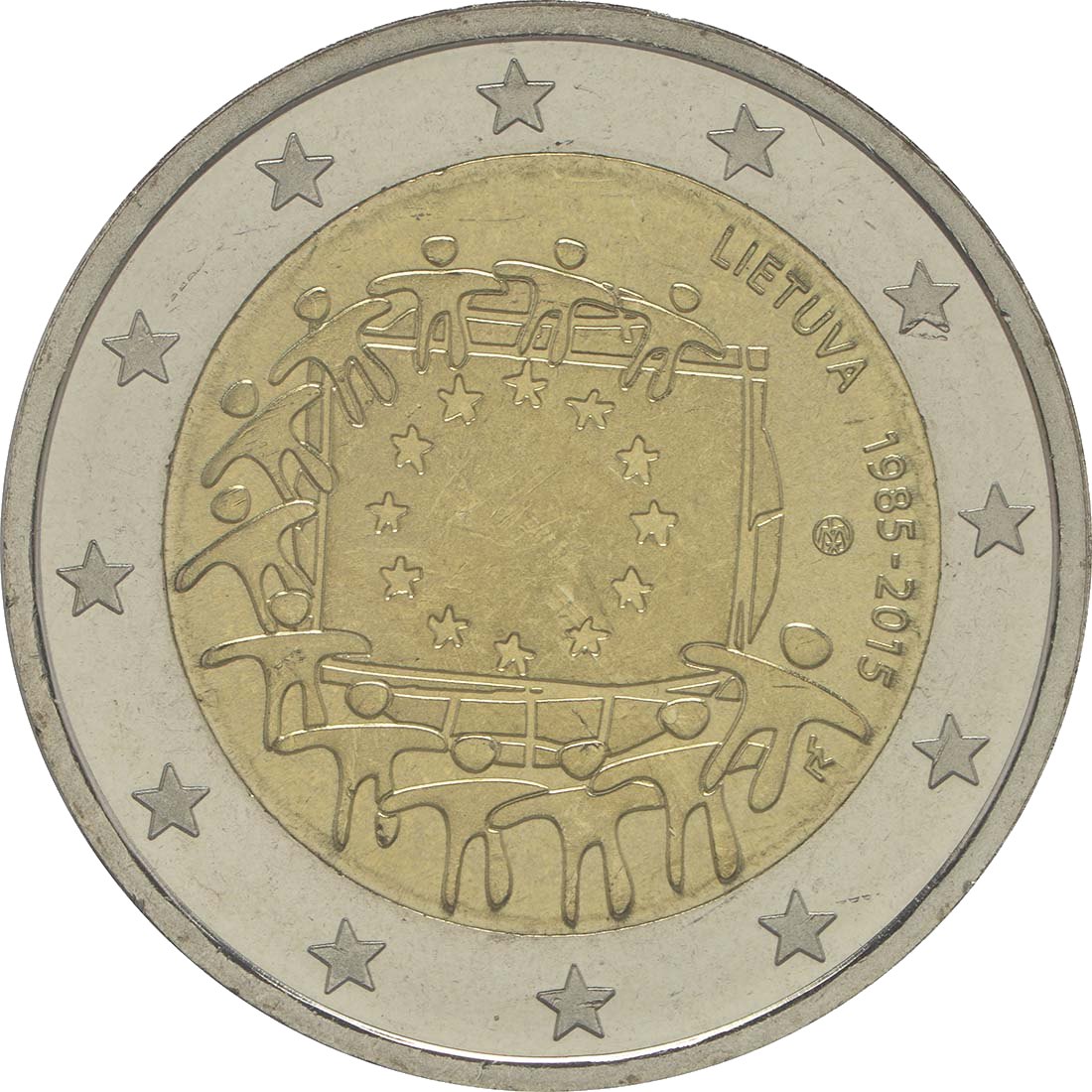
Obverse
Lithuania · 30 years of the EU flag
Issue date17 Nov 2015
Total mintage750,000
EU maximum750,000
Editions2
Edge letteringLAISVĖ ★ VIENYBĖ ★ GEROVĖ ★
InscriptionLIETUVA / 1985-2015
DesignerGeorgios Stamatopoulos
mintUAB Lietuvos monetų kalykla, Vilnius (Lithuania)
Issue occasion
The coin commemorates the 30th anniversary of the EU flag. The design by Georgios Stamatopoulos shows the EU flag as a unifying symbol for peoples and cultures with shared ideas and ideals; twelve stars take the form of human figures and welcome the birth of a new Europe. The inscription “LIETUVA”, the years “1985-2015”, the mintmark and the designer’s initials are also shown.
The design
The design features the EU flag as a symbol that brings together peoples and cultures with shared ideas and ideals for shaping a better future. Twelve stars take the form of people and welcome the birth of a new Europe. At the top right along the coin ring, the issuing country “LIETUVA” and the years “1985-2015” can be read. The mint mark is located on the right between the flag and the year indications. The designer’s initials (Georgios Stamatopoulos) are shown at the bottom right.
The twelve stars of the European flag are depicted on the outer coin ring.
The twelve stars of the European flag are depicted on the outer coin ring.
Background on the topic
The European flag did not originate within today’s European Union, but at the Council of Europe. Founded in 1949 and independent of the EU, this organisation is primarily concerned with human rights, democracy and the rule of law. In 1955, its Committee of Ministers adopted the blue banner with a circle of twelve golden stars. The European Communities later also sought a common visual symbol. The European Council approved the flag as an emblem in 1985; since 1986, it has been used by the European Community institutions. The European Union under its present name was not established until 1993, with the entry into force of the Maastricht Treaty.
The number of stars does not correspond to the number of member states. It therefore remained unchanged during the enlargements of the European Communities and the EU. The closed circle represents unity and solidarity, while the fixed number twelve represents completeness. Today, the flag identifies, among other things, EU institutions, programmes and projects. At the same time, it is often displayed alongside the national flags of the member states, without replacing them.
The anniversary was commemorated as a joint issue of the euro area. Such joint issues serve to make a political or historical reference shared throughout Europe visible on the national sides of the coins. There had previously been joint 2-euro issues for the anniversary of the Treaties of Rome, the Economic and Monetary Union, and ten years of euro cash.
For Lithuania, the issue fell in a special year: the country had introduced the euro on 1 January 2015 and thus participated for the first time in a joint 2-euro commemorative coin of the euro area. Lithuania had already joined the European Union in 2004. The flag anniversary thus connected the general European commemoration with Lithuania’s still recent membership of the common currency area. The uniform coin design emphasised the joint character, while the country name and mint identified the respective national issue.
The number of stars does not correspond to the number of member states. It therefore remained unchanged during the enlargements of the European Communities and the EU. The closed circle represents unity and solidarity, while the fixed number twelve represents completeness. Today, the flag identifies, among other things, EU institutions, programmes and projects. At the same time, it is often displayed alongside the national flags of the member states, without replacing them.
The anniversary was commemorated as a joint issue of the euro area. Such joint issues serve to make a political or historical reference shared throughout Europe visible on the national sides of the coins. There had previously been joint 2-euro issues for the anniversary of the Treaties of Rome, the Economic and Monetary Union, and ten years of euro cash.
For Lithuania, the issue fell in a special year: the country had introduced the euro on 1 January 2015 and thus participated for the first time in a joint 2-euro commemorative coin of the euro area. Lithuania had already joined the European Union in 2004. The flag anniversary thus connected the general European commemoration with Lithuania’s still recent membership of the common currency area. The uniform coin design emphasised the joint character, while the country name and mint identified the respective national issue.
eBay price analysis
For this issue, there is a price history based on actual eBay sales – with median, range and number of sales
View price analysis2 Euro BU – Single page
- Mintage
- 745,000
- Market price
- €6.90
- Edge lettering
- LAISVĖ ★ VIENYBĖ ★ GEROVĖ ★
Mintage by issue type
BU
745,000
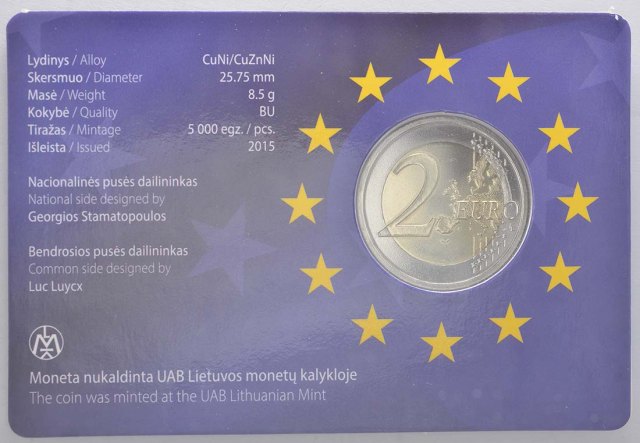
Coincard
5,000
More editions
1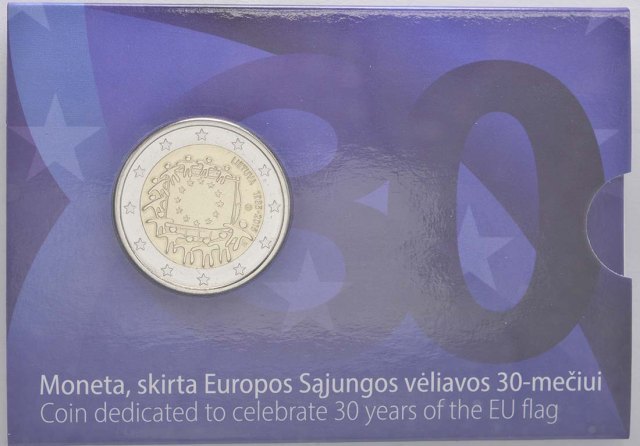
Official issue prices
2015 · Coincard: €9.00