
 Deutsch
 English
 Français
 Español
 Italiano
 Nederlands
 Português
 Slovenčina
 Hrvatski
 Slovenščina
 Lietuvių
 Eesti
Eesti Български


CC 192 2015
Blister pack
BU
Blister pack BU
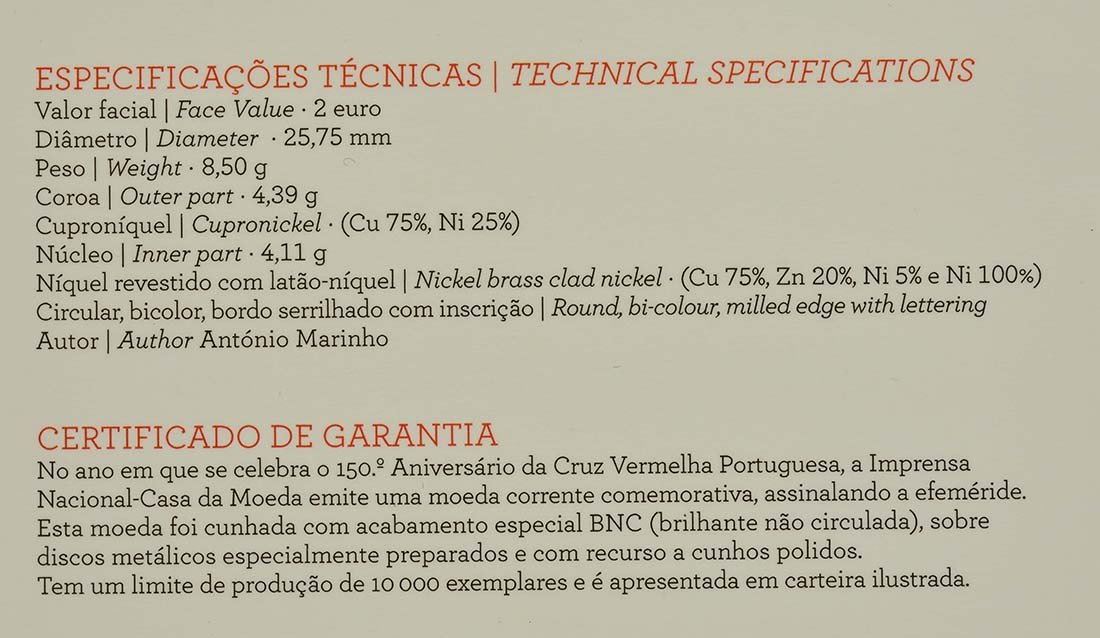
Portugal · 150 years of the Portuguese Red Cross
Mintage6,303
Issue date15 Apr 2015
PackagingBlister pack
Edge lettering5 Wappenschilde + 7 castles, evenly distributed
Market price€19.00
Issue occasion
The coin commemorates the 150th anniversary of the founding of the Portuguese Red Cross. The design features multiple cross symbols arranged in a row, illustrating the expansion of humanitarian aid at home and abroad, as well as the outline of a hand in the background, symbolizing medical assistance, cooperation, reconstruction and support. It is complemented by the inscription “CRUZ VERMELHA PORTUGUESA”, the Portuguese coat of arms, the name “PORTUGAL” and the years “1865” and “2015”.
The design
The design consists of the organisation’s familiar cross symbol, repeated several times to illustrate the expansion of humanitarian aid in Portugal and abroad. In the background, the outline of a hand can be seen, symbolising the various forms of assistance the organisation provides to people. The aid is predominantly medical in nature, but also includes cooperation, development and support. The inscription “CRUZ VERMELHA PORTUGUESA” runs in a semicircle on the left. The coat of arms and the name of the issuing country, “PORTUGAL”, appear at the top, while the two years “1865” and “2015” are shown at the bottom.
The twelve stars of the European flag are depicted on the coin’s outer ring.
The twelve stars of the European flag are depicted on the coin’s outer ring.
Background on the topic
The Portuguese Red Cross was established on 11 February 1865 on the initiative of the military physician José António Marques. Its foundation was connected with the emergence of the international Red Cross movement. This originated in the experiences of the Swiss merchant Henry Dunant after the Battle of Solferino in 1859. Dunant called for voluntary relief societies to care for the wounded, as well as binding rules to protect the injured and medical personnel in wartime.
In 1863, a committee was established in Geneva, from which the International Committee of the Red Cross (Internationales Komitee vom Roten Kreuz) later emerged. The following year, several states adopted the first Geneva Convention (Genfer Konvention). It obliged the contracting parties to care for wounded soldiers regardless of their affiliation and to protect medical personnel. José António Marques took part in the Geneva discussions as the Portuguese representative and subsequently contributed to the establishment of a corresponding relief organisation in Portugal.
The red cross on a white background was introduced as the protective and identifying emblem of the new movement. It is the colour reversal of the Swiss flag and thus refers to the place of origin of the Geneva initiative; it was not intended as a religious symbol. Its use is protected under international humanitarian law.
Over time, the activities of national Red Cross societies expanded beyond caring for war casualties. They include disaster relief, first-aid training, medical transport, health services and social support. They operate as voluntary relief societies in cooperation with government authorities, while maintaining their organisational independence and humanitarian principles. These include humanity, impartiality, neutrality, independence, voluntary service, unity and universality.
The coin issue therefore refers not only to the existence of a Portuguese organisation, but also to Portugal’s integration into an internationally regulated humanitarian movement. The anniversary provided the occasion to publicly address its long-term role in medical, social and disaster-related assistance.
In 1863, a committee was established in Geneva, from which the International Committee of the Red Cross (Internationales Komitee vom Roten Kreuz) later emerged. The following year, several states adopted the first Geneva Convention (Genfer Konvention). It obliged the contracting parties to care for wounded soldiers regardless of their affiliation and to protect medical personnel. José António Marques took part in the Geneva discussions as the Portuguese representative and subsequently contributed to the establishment of a corresponding relief organisation in Portugal.
The red cross on a white background was introduced as the protective and identifying emblem of the new movement. It is the colour reversal of the Swiss flag and thus refers to the place of origin of the Geneva initiative; it was not intended as a religious symbol. Its use is protected under international humanitarian law.
Over time, the activities of national Red Cross societies expanded beyond caring for war casualties. They include disaster relief, first-aid training, medical transport, health services and social support. They operate as voluntary relief societies in cooperation with government authorities, while maintaining their organisational independence and humanitarian principles. These include humanity, impartiality, neutrality, independence, voluntary service, unity and universality.
The coin issue therefore refers not only to the existence of a Portuguese organisation, but also to Portugal’s integration into an internationally regulated humanitarian movement. The anniversary provided the occasion to publicly address its long-term role in medical, social and disaster-related assistance.