
 Deutsch
 English
 Français
 Español
 Italiano
 Nederlands
 Português
 Slovenčina
 Hrvatski
 Slovenščina
 Lietuvių
 Eesti
Eesti Български

CC 19 2006
2 euro coin
BU
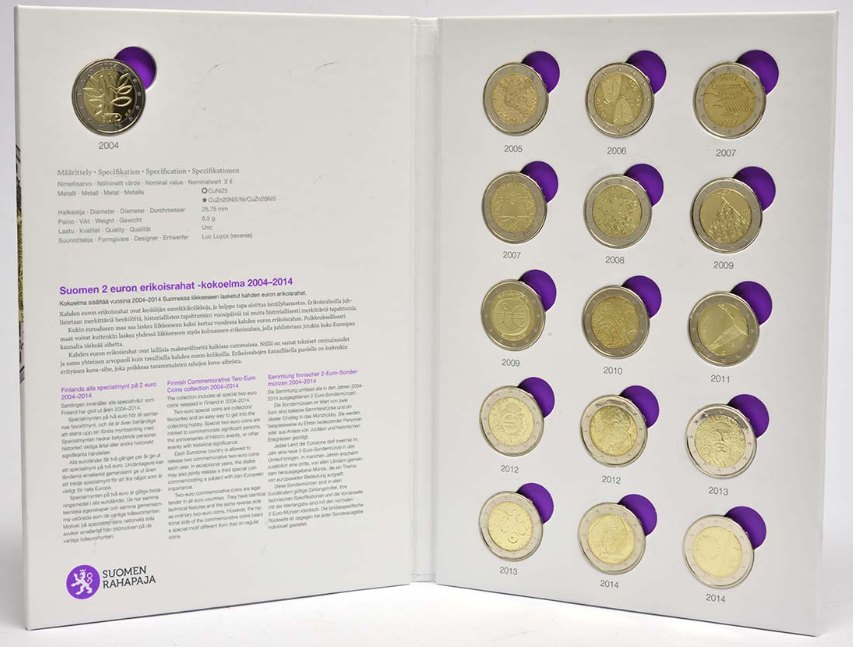
2 Euro, 16-coin set 2004–2014
Finland · 100 years of universal suffrage
Mintage1,500
Issue price€140.00
Issue date15 Nov 2015
PackagingCoin impression album
Edge letteringSUOMI FINLAND + 3 lion heads
Price of the set (16 coins)€135.00
Issue occasion
The commemorative coin honours 100 years of universal, equal, secret and free elections. The design shows the faces of a man and a woman separated by a line, as well as the date “1.10.06” and the year designation “20 FI 06”. The outer ring of the coin bears the twelve stars of the European Union.
The design
The coin depicts the faces of a man and a woman separated by a line. The date 1.10.06 is located on the left side of the coin, and the year with the country abbreviation in the middle, 20 FI 06, on the right side. The mint mark “M” is located to the left of each face. The outer ring of the coin bears the twelve stars of the European Union.
Background on the topic
In 1906, Finland was not yet an independent state, but an autonomous Grand Duchy within the Russian Empire. Until then, its political representation was based on a Diet in which the nobility, clergy, bourgeoisie and peasantry were represented separately. Large sections of the population had no right to vote. Women, too, were excluded from political participation.
The immediate background to the reform was the political unrest in the Russian Empire in 1905. In Finland, resistance to the restriction of autonomy became linked with demands for a more democratic representative body. A nationwide general strike increased the pressure on the Russian government and the Finnish institutions. The estate-based Diet was then replaced by a unicameral parliament with 200 members.
The electoral law adopted in 1906 granted women and men the right to vote and stand for election under the same conditions. Women were thus allowed not only to vote, but also to stand for a mandate themselves. Combining both rights went beyond earlier electoral reforms in other countries, which initially allowed women only to vote. In the first election after the reform, held in March 1907, 19 women entered the Finnish Parliament. They are regarded as the first female members of a national parliament anywhere in the world.
The new electoral system was also based on proportional representation and secret voting. The reform thus abolished the political division by estates and laid the foundation for today’s Eduskunta. Its practical impact initially remained limited by the position of the Russian emperor, who was able to dissolve Parliament repeatedly. It was not until Finnish independence in 1917 that the representative body operated within a sovereign state.
The 2006 coin issue marked the centenary of this parliamentary and electoral reform. The juxtaposition of the two genders refers to the core of the innovation at the time: equal political rights for women and men.
The immediate background to the reform was the political unrest in the Russian Empire in 1905. In Finland, resistance to the restriction of autonomy became linked with demands for a more democratic representative body. A nationwide general strike increased the pressure on the Russian government and the Finnish institutions. The estate-based Diet was then replaced by a unicameral parliament with 200 members.
The electoral law adopted in 1906 granted women and men the right to vote and stand for election under the same conditions. Women were thus allowed not only to vote, but also to stand for a mandate themselves. Combining both rights went beyond earlier electoral reforms in other countries, which initially allowed women only to vote. In the first election after the reform, held in March 1907, 19 women entered the Finnish Parliament. They are regarded as the first female members of a national parliament anywhere in the world.
The new electoral system was also based on proportional representation and secret voting. The reform thus abolished the political division by estates and laid the foundation for today’s Eduskunta. Its practical impact initially remained limited by the position of the Russian emperor, who was able to dissolve Parliament repeatedly. It was not until Finnish independence in 1917 that the representative body operated within a sovereign state.
The 2006 coin issue marked the centenary of this parliamentary and electoral reform. The juxtaposition of the two genders refers to the core of the innovation at the time: equal political rights for women and men.
Interesting Facts
In 2015, Mint of Finland issued a 2-euro commemorative coin set containing all 16 commemorative coin issues from 2004 to 2014. The coins are uncirculated. The mintage of the set is 1,500. The coins are already included in the mintage figures of the previous years. The issue price was €140.00.