
 Deutsch
 English
 Français
 Español
 Italiano
 Nederlands
 Português
 Slovenčina
 Hrvatski
 Slovenščina
 Lietuvių
 Eesti
Eesti Български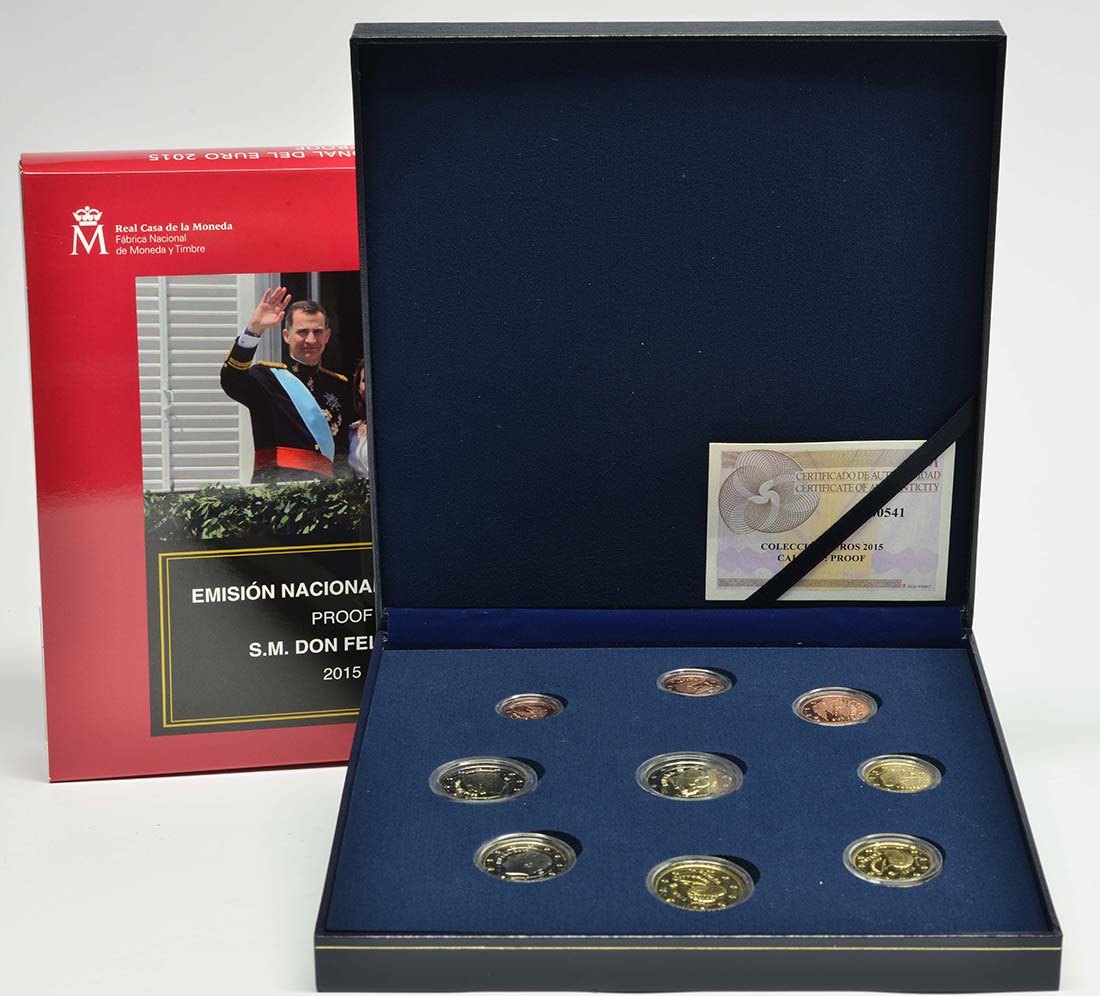

CC 188 2015
Coin set
Proof
Coin set proof
Spain · UNESCO World Cultural Heritage series, 6th issue, Cave of Altamira
Mintage1,800
Issue price€65.00
Issue date30 Jan 2015
PackagingCoin set
Edge lettering2 ★ ★ × 6, alternating upright/inverted
Market price€69.00
Issue occasion
The commemorative coin honours the Cave of Altamira as a UNESCO World Cultural and Natural Heritage Site. The design depicts the bison painting from the Cave of Altamira in Cantabria; “ESPAÑA” is inscribed in a semicircle above it, with the mint mark on the right.
The design
In the center of the coin, the bison painting from the Cave of Altamira in Cantabria is depicted. Above it, the issuing state “ESPAÑA” is engraved in capital letters in a semicircle, with the mint mark to its right and the year of issue “2015” below it.
The twelve stars of the European flag are depicted on the coin’s outer ring.
The twelve stars of the European flag are depicted on the coin’s outer ring.
Background on the topic
The cave is located near Santillana del Mar in northern Spain. Its paintings and engravings were created during the Paleolithic. The best-known animal depictions are predominantly attributed to the Magdalenian, a late phase of the Upper Paleolithic. However, studies show that the cave was used and decorated over a long period. In addition to bison, the depictions include horses, hinds, wild boar, hand stencils and abstract forms.
The prehistoric artists incorporated irregularities and natural bulges in the rock into the bodies of the animals. They used charcoal and mineral pigments such as ochre primarily for the paintings. Lines, areas of colour and shading created a three-dimensional effect. Altamira is therefore an important testimony to the technical abilities and worldview of Stone Age hunter-gatherer groups. The religious, social or ritual functions of the images cannot be determined with certainty.
In the 19th century, the landowner and amateur researcher Marcelino Sanz de Sautuola studied the cave. His daughter María drew his attention to the paintings on the ceiling. Sautuola’s assumption that they dated from the Paleolithic was initially rejected. Only after further comparable cave paintings had been discovered in France did their recognition as prehistoric art become established at the beginning of the 20th century. Altamira thus changed the prevailing view of the intellectual and artistic abilities of early humans.
The sensitive paintings suffered from changes in temperature, humidity and carbon dioxide levels, which were also caused by visitor traffic. Access to the original cave was therefore severely restricted. A detailed reconstruction of central cave areas is located in the neighbouring museum.
The issue belongs to a Spanish coin series that has featured UNESCO World Heritage Sites in the country annually since 2010. Altamira was therefore not selected because of a specific anniversary, but as part of this ongoing representation of Spanish World Heritage Sites. Since 2008, the UNESCO listing has included, in addition to Altamira, further caves with Paleolithic art in northern Spain.
The prehistoric artists incorporated irregularities and natural bulges in the rock into the bodies of the animals. They used charcoal and mineral pigments such as ochre primarily for the paintings. Lines, areas of colour and shading created a three-dimensional effect. Altamira is therefore an important testimony to the technical abilities and worldview of Stone Age hunter-gatherer groups. The religious, social or ritual functions of the images cannot be determined with certainty.
In the 19th century, the landowner and amateur researcher Marcelino Sanz de Sautuola studied the cave. His daughter María drew his attention to the paintings on the ceiling. Sautuola’s assumption that they dated from the Paleolithic was initially rejected. Only after further comparable cave paintings had been discovered in France did their recognition as prehistoric art become established at the beginning of the 20th century. Altamira thus changed the prevailing view of the intellectual and artistic abilities of early humans.
The sensitive paintings suffered from changes in temperature, humidity and carbon dioxide levels, which were also caused by visitor traffic. Access to the original cave was therefore severely restricted. A detailed reconstruction of central cave areas is located in the neighbouring museum.
The issue belongs to a Spanish coin series that has featured UNESCO World Heritage Sites in the country annually since 2010. Altamira was therefore not selected because of a specific anniversary, but as part of this ongoing representation of Spanish World Heritage Sites. Since 2008, the UNESCO listing has included, in addition to Altamira, further caves with Paleolithic art in northern Spain.
Interesting Facts
This coin set featuring the portrait of the new royal couple contains all eight circulation coins from 1 cent to 2 euros, as well as this 2-euro commemorative coin “Altamira” (face value: 5,88 €).