
 Deutsch
 English
 Français
 Español
 Italiano
 Nederlands
 Português
 Slovenčina
 Hrvatski
 Slovenščina
 Lietuvių
 Eesti
Eesti Български

CC 154 2013
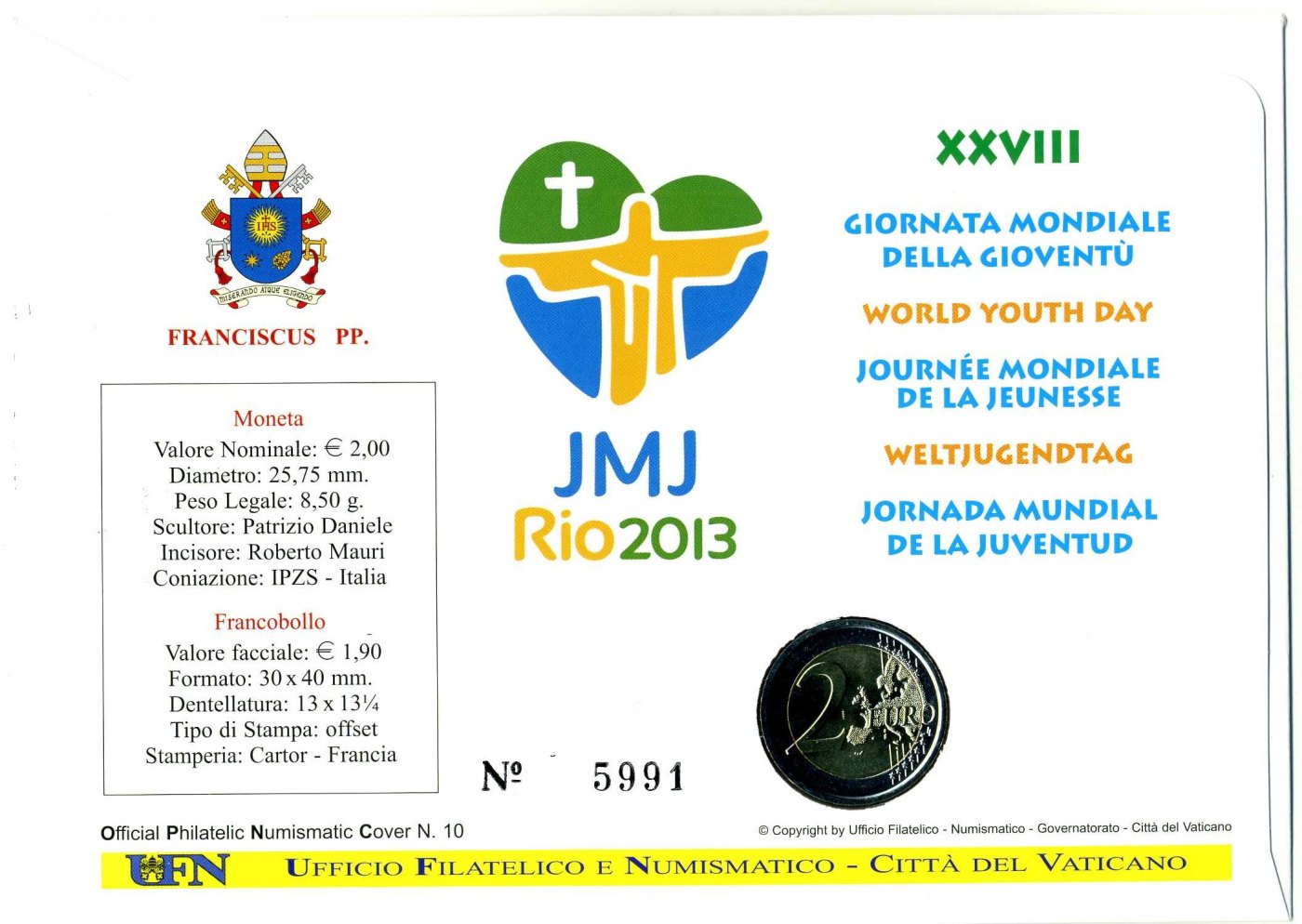
Numismatic cover
BU
Numismatic cover
Vatican · XXVIII World Youth Day Rio de Janeiro
Mintage12,000
Issue price€45.00
Issue date15 Oct 2013
PackagingNumismatic cover
Edge lettering2 ★ × 6, alternately upright/inverted
Issue occasion
The coin commemorates the 28th World Youth Day in Rio de Janeiro in July 2013. The design shows the landmark “Christ the Redeemer” (Christo Redentor), surrounded by several young people. Above it, in a semicircle, is the inscription “XXVIII G.M.G. CITTÀ DEL VATICANO RIO 2013”.
The design
The coin design depicts Rio de Janeiro’s best-known landmark, Christ the Redeemer, and several young people grouped around the statue; above them, in a semicircle, is the inscription “XXVIII G.M.G. CITTÀ DEL VATICANO RIO 2013”, and on the right-hand side the mint mark “R” and the artist’s name “P DANIELE”.
The twelve stars of the European flag are depicted on the outer ring of the coin.
The twelve stars of the European flag are depicted on the outer ring of the coin.
Background on the topic
World Youth Day (Weltjugendtag) is an international gathering of young Catholics with the pope. Its origins go back to gatherings in Rome during the Holy Year 1984 and the International Year of Youth 1985 proclaimed by the United Nations. Pope John Paul II subsequently established World Youth Days as regular events. In addition to the large international gatherings, further youth days are held in local churches. The abbreviation “G.M.G.” on the coin stands for the Italian designation “Giornata Mondiale della Gioventù”.
The gathering in Brazil was held under the biblical motto “Go and make disciples of all nations”. The program included religious services, prayers, catecheses and cultural events. Due to heavy rainfall, the planned closing event in the Guaratiba district had to be relocated; it ultimately took place at Copacabana. For Pope Francis, the journey was his first foreign trip after his election as pope in March of the same year. As an Argentine, he was also the first pope from Latin America. This gave the venue in Brazil an additional ecclesiastical-political significance.
The statue of Christ on Corcovado was inaugurated in 1931. It stands on a mountain above Rio de Janeiro and depicts Christ with his arms outstretched to the sides. The monument is made of reinforced concrete and clad in soapstone. The Brazilian engineer Heitor da Silva Costa directed the design; the French-Polish sculptor Paul Landowski was involved in the sculptural execution. The statue connects the Christian message of the gathering with an immediately recognizable reference to the host city.
The fact that the State of Vatican City (Vatikanstadt) took up this occasion can be explained by its close connection with the Holy See and the papal office. World Youth Days are events of the Catholic Church initiated by the pope. The coin issue thus documents both a global ecclesiastical gathering and an early stage of the pontificate of Pope Francis.
The gathering in Brazil was held under the biblical motto “Go and make disciples of all nations”. The program included religious services, prayers, catecheses and cultural events. Due to heavy rainfall, the planned closing event in the Guaratiba district had to be relocated; it ultimately took place at Copacabana. For Pope Francis, the journey was his first foreign trip after his election as pope in March of the same year. As an Argentine, he was also the first pope from Latin America. This gave the venue in Brazil an additional ecclesiastical-political significance.
The statue of Christ on Corcovado was inaugurated in 1931. It stands on a mountain above Rio de Janeiro and depicts Christ with his arms outstretched to the sides. The monument is made of reinforced concrete and clad in soapstone. The Brazilian engineer Heitor da Silva Costa directed the design; the French-Polish sculptor Paul Landowski was involved in the sculptural execution. The statue connects the Christian message of the gathering with an immediately recognizable reference to the host city.
The fact that the State of Vatican City (Vatikanstadt) took up this occasion can be explained by its close connection with the Holy See and the papal office. World Youth Days are events of the Catholic Church initiated by the pope. The coin issue thus documents both a global ecclesiastical gathering and an early stage of the pontificate of Pope Francis.