
 Deutsch
 English
 Français
 Español
 Italiano
 Nederlands
 Português
 Slovenčina
 Hrvatski
 Slovenščina
 Lietuvių
 Eesti
Eesti Български


CC 135 2013
2 euro coin
Proof
2 Euro Proof
France · Joint issue Germany / France 50th anniversary of the Élysée Treaty
Mintage10,000
Issue price€20.00
Issue date21 Jan 2013
Packagingin case
Edge lettering2 ★ ★ × 6, alternating upright/inverted
Market price€45.00
Issue occasion
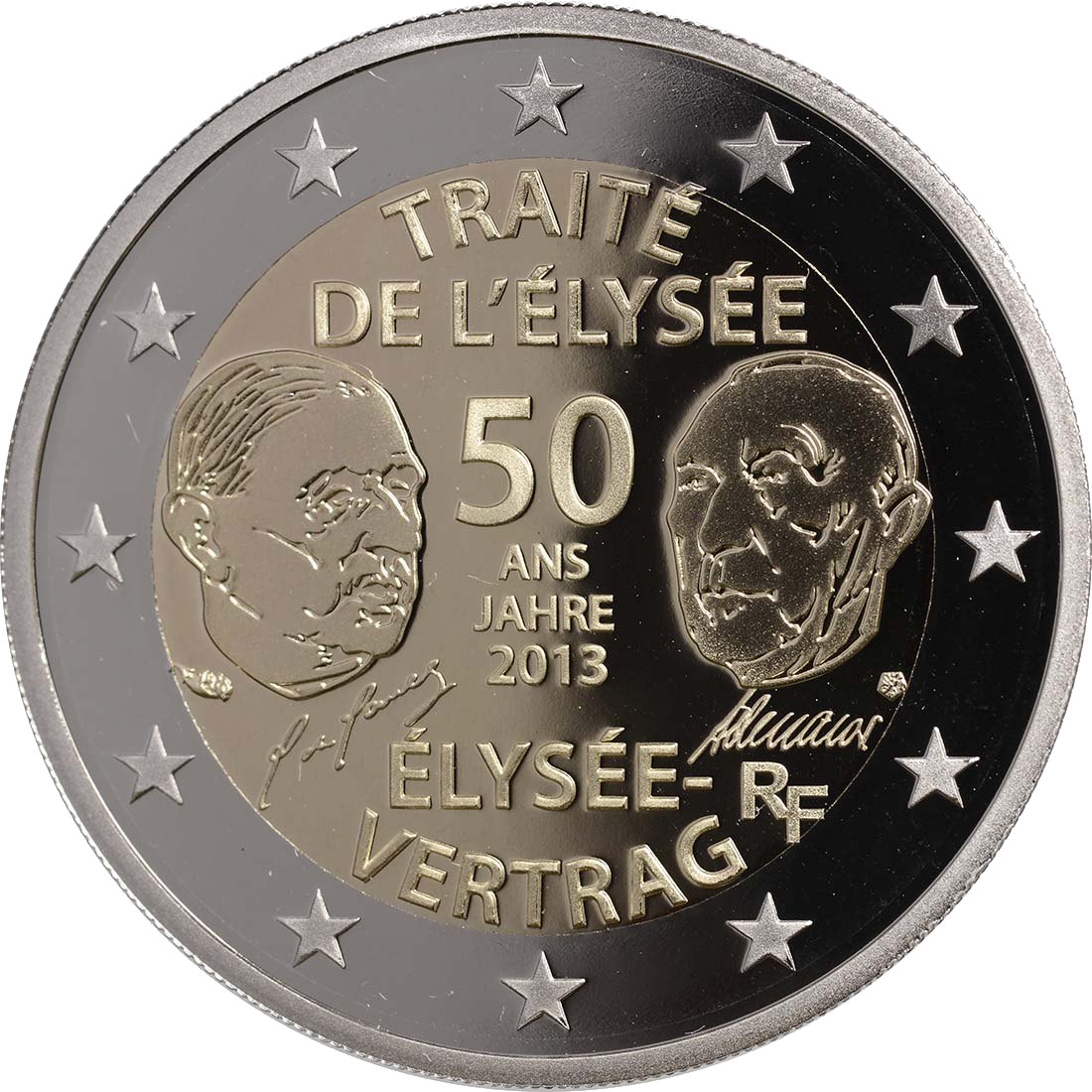
The coin commemorates the 50th anniversary of the signing of the Élysée Treaty (Élysée-Vertrag). The design features stylised portraits of the signatories at the time, Konrad Adenauer and Charles de Gaulle, with their signatures. Between them are “50 ANS JAHRE” and “2013”, supplemented by the inscriptions “TRAITÉ DE L’ÉLYSÉE” and “ÉLYSÉE-VERTRAG”.
The design
The coin designed by Yves Sampo of Monnaie de Paris, Stefanie Lindner of Staatliche Münze Berlin, Alina Hoyer (Berlin) and Sneschana Russewa-Hoyer (Berlin) shows the stylized portraits of the signatories to the Élysée Treaty (the then Chancellor of the Federal Republic of Germany, Konrad Adenauer, and the then President of the French Republic, Charles de Gaulle), with their signatures, the inscription “50 YEARS” and the year “2013” between them, as well as the inscription “ÉLYSÉE TREATY” along the upper and lower edges of the coin’s inner disc. The mintmark of the mint and the mark of the issuing country (“RF”) are located on the right edge, while the mint master’s mark—a flower—is located on the left edge of the coin’s inner disc.
The twelve stars of the European flag are depicted on the outer ring of the coin.
The twelve stars of the European flag are depicted on the outer ring of the coin.
Background on the topic
The Élysée Treaty was concluded on 22 January 1963 at the Élysée-Palast in Paris. It arose against the backdrop of a long history of German-French rivalry and three wars since 1870, most recently the Second World War and the German occupation of France. As early as the 1950s, the two states had cooperated in European integration. The treaty was intended, however, to establish reconciliation permanently in the routine work of government.
It provided for regular meetings of the heads of state and government, as well as consultations on foreign, defence, education and youth policy. Governments and authorities were to coordinate their positions as early as possible. One concrete consequence was the establishment of the Deutsch-Französisches Jugendwerk in 1963. It promotes meetings, exchange programmes and language learning, and was intended particularly to bring younger generations into contact with one another.
Konrad Adenauer was the first Federal Chancellor of the Bundesrepublik Deutschland from 1949 to 1963. His policy aimed to integrate West Germany into the Western alliances and to bring it closer to France. During the Second World War, Charles de Gaulle had led Free France. Later, he shaped the Fifth Republic and served as President of the Republic from 1959 to 1969. He sought a more independent European policy in which cooperation with the Bundesrepublik would play a central role.
The views of the two sides did not completely coincide. The Deutscher Bundestag supplemented the Act approving the treaty with a preamble that, among other things, reaffirmed ties with the United States and NATO, as well as European integration. This limited de Gaulle’s concept of a European policy more independent of the United States.
The anniversary provided an occasion for a joint German and French coin issue with the same theme. The choice refers to the institutionalised partnership between the two states, which has since been continued through regular government consultations, joint institutions and numerous social exchange programmes.
It provided for regular meetings of the heads of state and government, as well as consultations on foreign, defence, education and youth policy. Governments and authorities were to coordinate their positions as early as possible. One concrete consequence was the establishment of the Deutsch-Französisches Jugendwerk in 1963. It promotes meetings, exchange programmes and language learning, and was intended particularly to bring younger generations into contact with one another.
Konrad Adenauer was the first Federal Chancellor of the Bundesrepublik Deutschland from 1949 to 1963. His policy aimed to integrate West Germany into the Western alliances and to bring it closer to France. During the Second World War, Charles de Gaulle had led Free France. Later, he shaped the Fifth Republic and served as President of the Republic from 1959 to 1969. He sought a more independent European policy in which cooperation with the Bundesrepublik would play a central role.
The views of the two sides did not completely coincide. The Deutscher Bundestag supplemented the Act approving the treaty with a preamble that, among other things, reaffirmed ties with the United States and NATO, as well as European integration. This limited de Gaulle’s concept of a European policy more independent of the United States.
The anniversary provided an occasion for a joint German and French coin issue with the same theme. The choice refers to the institutionalised partnership between the two states, which has since been continued through regular government consultations, joint institutions and numerous social exchange programmes.
eBay price analysis
For this issue, there is a price history based on actual eBay sales – with median, range and number of sales
View price analysis