
 Deutsch
 English
 Français
 Español
 Italiano
 Nederlands
 Português
 Slovenčina
 Hrvatski
 Slovenščina
 Lietuvių
 Eesti
Eesti Български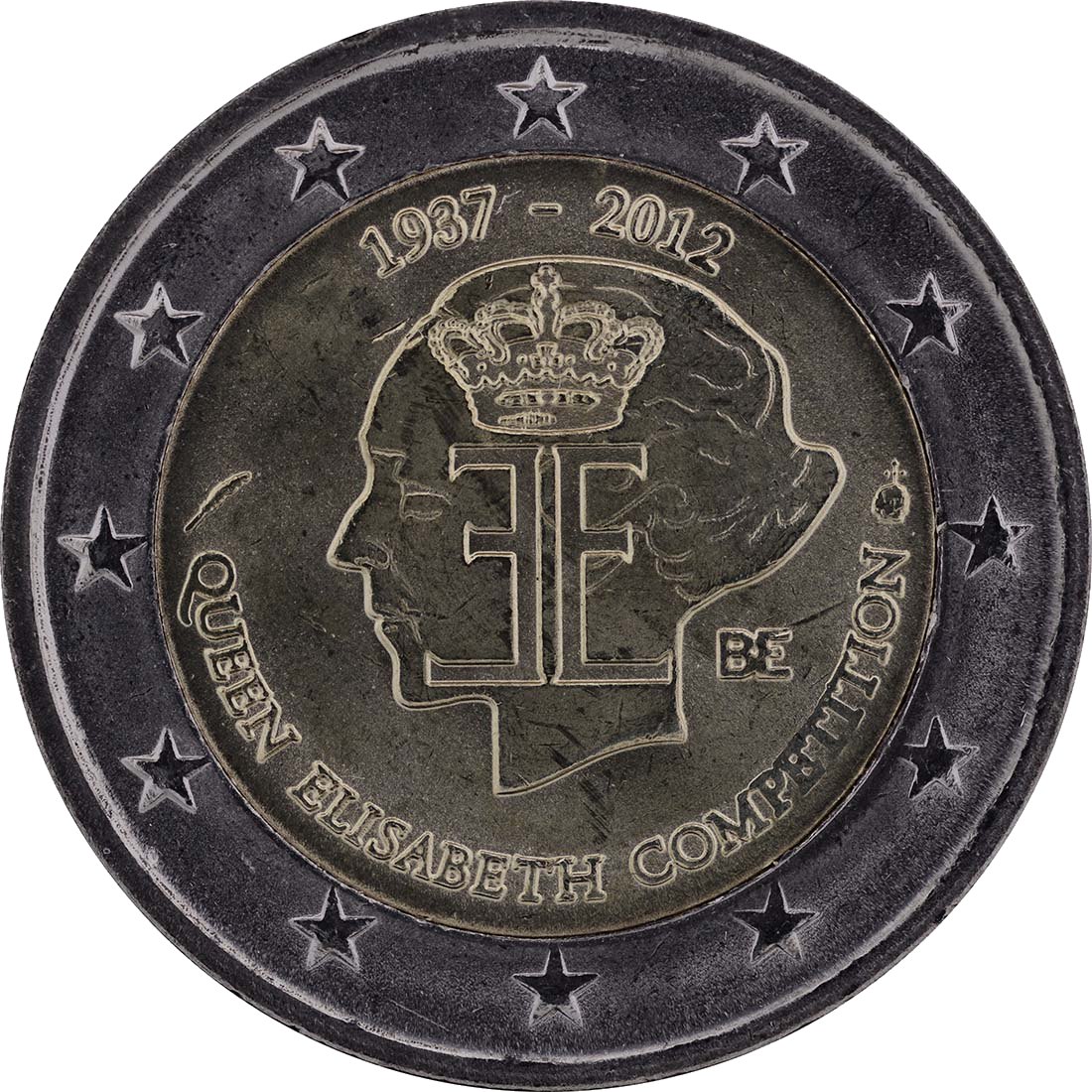

CC 125 2012
2 euro coin
BU Main coin Bank issue
2 Euro BU
Belgium · 75 years Königin-Elisabeth-Wettbewerb
Mintage5,000,000
Issue date6 Jun 2012
Edge lettering2 ★ ★ × 6, alternating upright/inverted
Market price€5.30
Issue occasion
The coin commemorates 75 years of the music competition “Concours Reine Elisabeth” (“Queen Elisabeth Competition”). The design shows its emblem in front of a left-facing profile of Queen Elisabeth, as well as the years 1937–2012 and the inscription “QUEEN ELISABETH COMPETITION”. Also included are the mint master’s mark, the mark of the Brussels mint and the country code “BE”.
The design
The inner part of the coin shows the emblem of the music competition “Concours Reine Elisabeth” in front of a left-facing portrait of Queen Elisabeth. To the left and right of the portrait are the mint master’s mark and the mark of the Brussels mint (the head of the Archangel Michael wearing a helmet). The years 1937-2012 are shown above the portrait. The inscription “QUEEN ELISABETH COMPETITION” is located below the portrait. The country code “BE” is engraved to the right of the portrait.
The outer ring of the coin features the twelve stars of the European flag.
The outer ring of the coin features the twelve stars of the European flag.
Background on the topic
Queen Elisabeth of Belgium (1876–1965) came from the House of Wittelsbach and was married to King Albert I. She played the violin herself and promoted music, visual arts and science. Among others, she received violin lessons from Eugène Ysaÿe, a Belgian violinist, composer and conductor. Their shared interest in the training of young musicians led to the idea of an international competition.
The first edition was held under the name “Concours Eugène Ysaÿe”. Ysaÿe had died shortly beforehand, but had still contributed to the basic principles of the competition. Initially, it was aimed at violinists, and later also at pianists. The early prize-winners included the Soviet musicians David Oistrach and Emil Gilels. The Second World War interrupted the competition’s continuation. After it resumed, the competition received its present name in 1951 and has been held in Brussels ever since.
One of its distinctive features is the intensive final round. Within a limited period, the finalists prepare a work specially commissioned for the competition that has not previously been published. They live and work in isolation and without assistance from their teachers. In addition to violin and piano, further disciplines were later added, including singing and composition. The performances in the final round traditionally take place with an orchestra.
The competition is also connected with the Belgian monarchy and state-supported cultural patronage. After Elisabeth, Queen Fabiola assumed the honorary presidency; this role was later continued by Queen Mathilde. The recognition of young musicians and their international public profile are at the centre, rather than merely the awarding of prize money.
For Belgium, the anniversary therefore provided an occasion to commemorate a long-established cultural institution with a royal namesake and international participation. The choice of a circulation coin brought together music history, Belgian cultural policy and the role of the royal family in a single design.
The first edition was held under the name “Concours Eugène Ysaÿe”. Ysaÿe had died shortly beforehand, but had still contributed to the basic principles of the competition. Initially, it was aimed at violinists, and later also at pianists. The early prize-winners included the Soviet musicians David Oistrach and Emil Gilels. The Second World War interrupted the competition’s continuation. After it resumed, the competition received its present name in 1951 and has been held in Brussels ever since.
One of its distinctive features is the intensive final round. Within a limited period, the finalists prepare a work specially commissioned for the competition that has not previously been published. They live and work in isolation and without assistance from their teachers. In addition to violin and piano, further disciplines were later added, including singing and composition. The performances in the final round traditionally take place with an orchestra.
The competition is also connected with the Belgian monarchy and state-supported cultural patronage. After Elisabeth, Queen Fabiola assumed the honorary presidency; this role was later continued by Queen Mathilde. The recognition of young musicians and their international public profile are at the centre, rather than merely the awarding of prize money.
For Belgium, the anniversary therefore provided an occasion to commemorate a long-established cultural institution with a royal namesake and international participation. The choice of a circulation coin brought together music history, Belgian cultural policy and the role of the royal family in a single design.
eBay price analysis
For this issue, there is a price history based on actual eBay sales – with median, range and number of sales
View price analysis