
 Deutsch
 English
 Français
 Español
 Italiano
 Nederlands
 Português
 Slovenčina
 Hrvatski
 Slovenščina
 Lietuvių
 Eesti
Eesti Български
Reverse

Obverse

Austria · 10 years of euro cash
Issue date2 Jan 2012
Total mintage11,060,000
EU maximum11,300,000
Editions3
Edge lettering2 EURO ★★★ × 4, alternating upright/inverted
InscriptionREPUBLIK ÖSTERREICH / 2002 / 2012
DesignerHelmut Andexlinger
mintMünze Österreich AG, Wien
Issue occasion
The common commemorative coin commemorates the tenth anniversary of the introduction of the euro. At the centre is the euro sign as a symbol of its international importance; grouped around it are people, the ECB Tower, ships, factories and wind turbines as symbols of the financial world, trade, industry, energy, and research and development. The year numbers “2002-2012” complete the design; on the Luxembourg issue, the portrait of the Grand Duke also appears as a tilt effect.
The design
The euro sign in the inner part of the coin illustrates that the euro has become an exceptionally important factor in Europe and worldwide and has developed into a global player in the international monetary system over the past ten years. The design elements arranged around the euro sign symbolise the importance of the euro for people, the financial world (ECB tower), trade (ships), industry (factories), the energy sector, and research and development (wind turbines). The artist’s initials “AH” appear below the image of the ECB tower. The names of the issuing countries in their respective languages are positioned centrally above the design, with the dates 2002–2012 inscribed below.
The outer ring of the coin depicts the twelve stars of the European flag.
The outer ring of the coin depicts the twelve stars of the European flag.
Background on the topic
The euro emerged in the course of the European Economic and Monetary Union. Its foundation was the framework agreed in the Treaty of Maastricht for a common currency and a common monetary policy. On 1 January 1999, the euro was initially introduced as book money; at the same time, the exchange rates of the participating national currencies were irrevocably fixed. Transfers, financial transactions and government accounts could already be settled in euros, while national banknotes and coins continued to be used in everyday life.
Euro cash came into circulation in twelve member states on 1 January 2002. During a short transition period, D-Mark, francs, lire, pesetas and other former currencies were withdrawn. The changeover was an extensive logistical operation: banks, retailers and cash-machine operators had to replace cash holdings and accounting systems. For the population, the monetary union thus became directly visible for the first time in everyday payment transactions. By 2012, the euro area had grown through the accession of additional states; most recently, Estonia had adopted the euro in 2011.
The monetary policy of the euro area is conducted by the Eurosystem, which consists of the European Central Bank and the national central banks of the euro area countries. While the banknotes have the same design in all countries, the coins have a common European side and a national side. Regardless of this design, they are legal tender throughout the euro area.
The issue took place during a period in which the European sovereign-debt and banking crisis was a major political concern regarding the functioning of the monetary union. However, the official occasion for the issue remained exclusively the anniversary of the introduction of euro cash.
The finance ministers opted for a coordinated issue because the currency changeover affected all euro area countries at the time jointly. The specific appearance was not determined solely by the authorities: following a Europe-wide design competition, a specialist jury selected five proposals. Citizens and residents of the euro area subsequently chose the design by the Austrian engraver Helmut Andexlinger in a public online vote. The issue thus combined the shared anniversary with a cross-border selection process.
Euro cash came into circulation in twelve member states on 1 January 2002. During a short transition period, D-Mark, francs, lire, pesetas and other former currencies were withdrawn. The changeover was an extensive logistical operation: banks, retailers and cash-machine operators had to replace cash holdings and accounting systems. For the population, the monetary union thus became directly visible for the first time in everyday payment transactions. By 2012, the euro area had grown through the accession of additional states; most recently, Estonia had adopted the euro in 2011.
The monetary policy of the euro area is conducted by the Eurosystem, which consists of the European Central Bank and the national central banks of the euro area countries. While the banknotes have the same design in all countries, the coins have a common European side and a national side. Regardless of this design, they are legal tender throughout the euro area.
The issue took place during a period in which the European sovereign-debt and banking crisis was a major political concern regarding the functioning of the monetary union. However, the official occasion for the issue remained exclusively the anniversary of the introduction of euro cash.
The finance ministers opted for a coordinated issue because the currency changeover affected all euro area countries at the time jointly. The specific appearance was not determined solely by the authorities: following a Europe-wide design competition, a specialist jury selected five proposals. Citizens and residents of the euro area subsequently chose the design by the Austrian engraver Helmut Andexlinger in a public online vote. The issue thus combined the shared anniversary with a cross-border selection process.
eBay price analysis
For this issue, there is a price history based on actual eBay sales – with median, range and number of sales
View price analysis2 Euro BU – Single page
- Mintage
- 11,000,000
- Market price
- €3.50
- Edge lettering
- 2 EURO ★★★ × 4, alternating upright/inverted
Mintage by issue type
BU
11,000,000
Coin set
60,000
2 Editions
More editions
2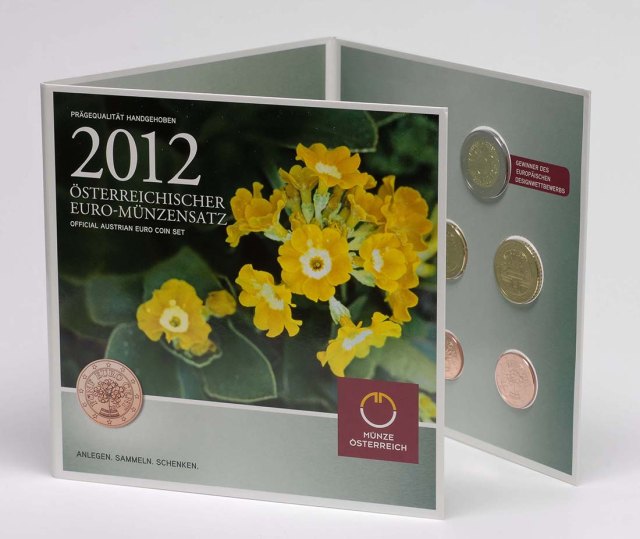
Mintages
Österreich
11,060,000Circulation: 11,000,000
BU Mint Set: 50,000
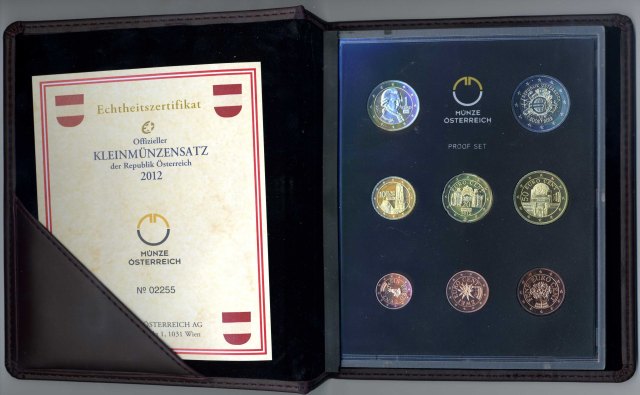
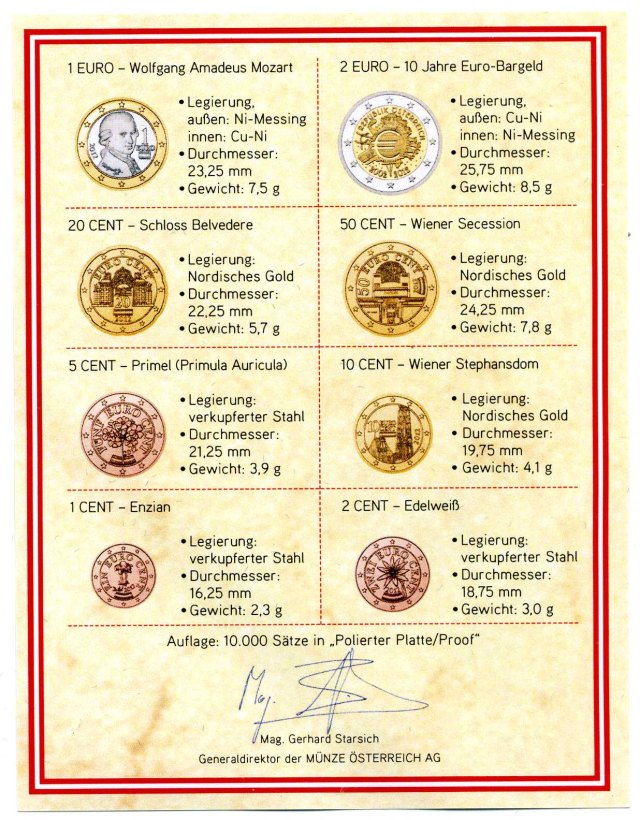
Coin set proof: 10,000
Official issue prices
2012 · BU Mint Set: €24.00
2012 · Coin set proof: €75.00
Additional information
KMS HGH (handgehoben) und KMS PP nur mit 2CC. Die normale Kursmünze wird dieses Jahr nicht geprägt.