
 Deutsch
 English
 Français
 Español
 Italiano
 Nederlands
 Português
 Slovenčina
 Hrvatski
 Slovenščina
 Lietuvių
 Eesti
Eesti Български
CC 102 2011
2 euro coin
BU
2 Euro, Set of 16
Finland · 200 years of the Bank of Finland
Mintage1,500
Issue price€140.00
Issue date15 Nov 2015
PackagingCoin impression album
Edge letteringSUOMI FINLAND + 3 lion heads
Price of the set (16 coins)€135.00
Issue occasion
The commemorative coin honours the 200th anniversary of the Bank of Finland. The design features Finland’s national bird, the whooper swan, with a wing spread between the years “1811” and “2011”. The letter “V” refers to the artist Hannu Veijalainen.
The design
The inner part of the coin depicts Finland’s national bird, the whooper swan. One of the swan’s wings is spread between the years “1811” (below on the right) and “2011” (above on the left). The letter “V” below the left wing stands for the surname of the artist Hannu Veijalainen. The issuing country “FI” and the mintmark are engraved along the lower edge of the inner part of the coin.
The twelve stars of the European flag are depicted on the coin’s outer ring.
The twelve stars of the European flag are depicted on the coin’s outer ring.
Background on the topic
The founding of the Bank of Finland (Finnische Nationalbank) was connected with the political reorganisation of Northern Europe following the Finnish War of 1808 to 1809. Sweden ceded Finland to the Russian Empire; the country was incorporated into the Tsarist Empire as the Grand Duchy of Finland with its own administrative bodies. Tsar Alexander I then ordered the establishment of a Finnish banking institution. It was intended to grant loans, accept deposits and issue banknotes. At the same time, it was necessary to regulate the coexistence of Swedish and Russian means of payment.
The bank’s first headquarters were in Turku, the country’s administrative centre at the time. After Helsinki had been designated the capital of the Grand Duchy, the bank moved there as well. During the 19th century, it became more closely connected with Finland’s political institutions. Since 1868, it had been subordinate to the Finnish Estates, from which Parliament later emerged. This parliamentary affiliation continues in modified form to this day.
Another step towards economic independence was the introduction of the Finnish mark in 1860. The Nationalbank assumed central responsibilities for issuing and stabilising the currency. It continued to exist after Finland gained state independence. With the transition to the euro, it became part of the European System of Central Banks and the Eurosystem. Since then, it has participated in the common monetary policy and implements its decisions in Finland.
The Whooper Swan (Singschwan) refers beyond the bank’s actual operations to Finnish ideas of nature and culture. Swans appear, among other things, in themes from the national epic Kalevala and in the Finnish art and music associated with it, such as The Swan of Tuonela (Schwan von Tuonela) by Jean Sibelius. The choice of such a symbol connects the institutional anniversary with national history. The occasion for the issue was therefore not only the long existence of an authority, but also the continuity of Finland’s own monetary and currency institutions across several political orders.
The bank’s first headquarters were in Turku, the country’s administrative centre at the time. After Helsinki had been designated the capital of the Grand Duchy, the bank moved there as well. During the 19th century, it became more closely connected with Finland’s political institutions. Since 1868, it had been subordinate to the Finnish Estates, from which Parliament later emerged. This parliamentary affiliation continues in modified form to this day.
Another step towards economic independence was the introduction of the Finnish mark in 1860. The Nationalbank assumed central responsibilities for issuing and stabilising the currency. It continued to exist after Finland gained state independence. With the transition to the euro, it became part of the European System of Central Banks and the Eurosystem. Since then, it has participated in the common monetary policy and implements its decisions in Finland.
The Whooper Swan (Singschwan) refers beyond the bank’s actual operations to Finnish ideas of nature and culture. Swans appear, among other things, in themes from the national epic Kalevala and in the Finnish art and music associated with it, such as The Swan of Tuonela (Schwan von Tuonela) by Jean Sibelius. The choice of such a symbol connects the institutional anniversary with national history. The occasion for the issue was therefore not only the long existence of an authority, but also the continuity of Finland’s own monetary and currency institutions across several political orders.
Interesting Facts
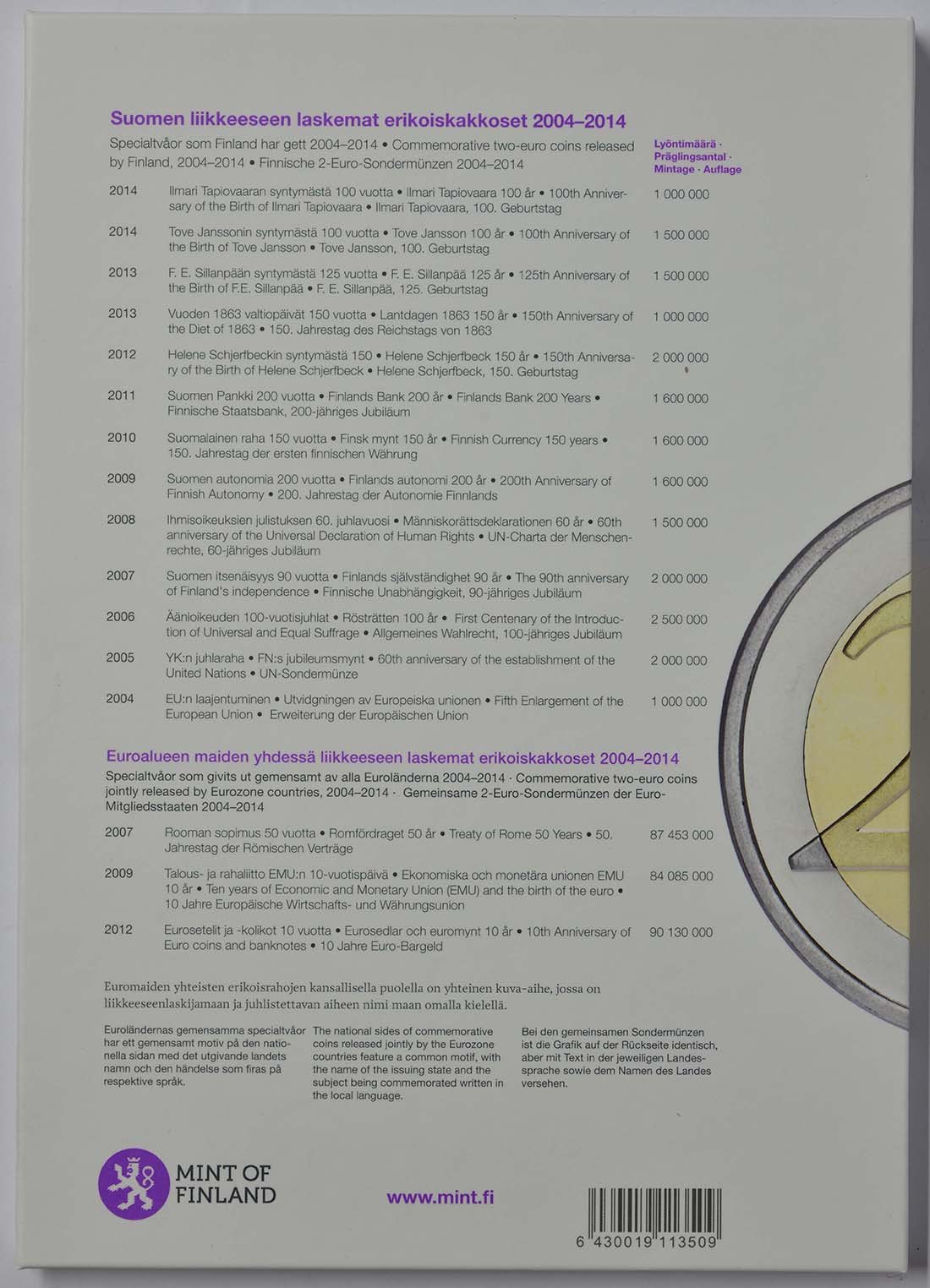
In 2015, Mint of Finland issued a 2-euro commemorative coin set containing all 16 commemorative coin issues from 2004 to 2014. The coins are uncirculated. The mintage of the set is 1,500. The coins are already included in the mintage figures for previous years. The issue price was 140.00 €.