
 Deutsch
 English
 Français
 Español
 Italiano
 Nederlands
 Português
 Slovenčina
 Hrvatski
 Slovenščina
 Lietuvių
 Eesti
Eesti Български
Reverse

Obverse
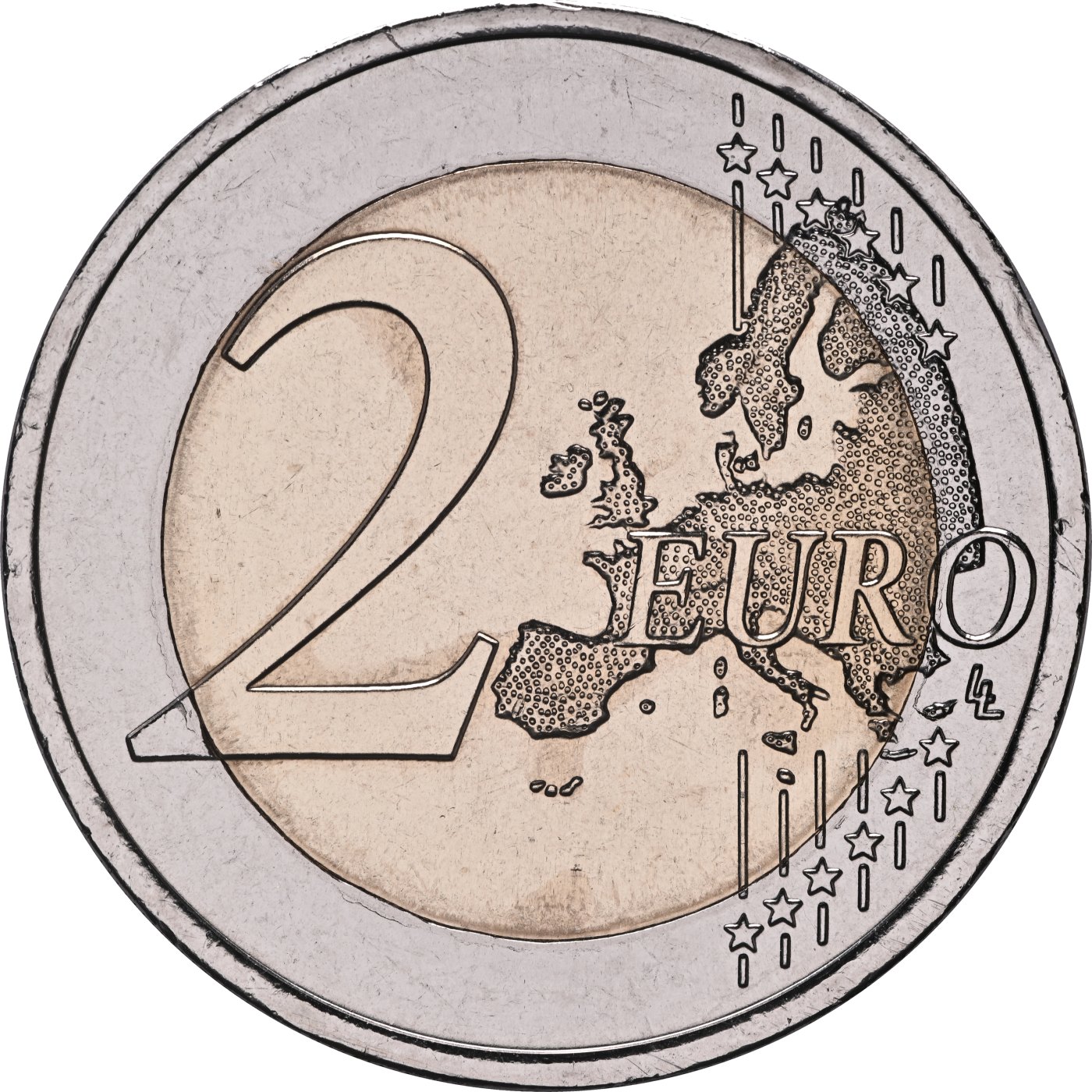
Portugal · 500th birthday of Fernão Mendes Pinto
Issue date8 Sept 2011
Total mintage519,995
EU maximum520,000
Editions3
Edge lettering5 Wappenschilde + 7 castles, evenly distributed
InscriptionFERNÃO MENDES PINTO / 1511 / 2011 / Portugal
DesignerFernando Branco / Isabel Carriĉo
mintImprensa Nacional Casa da Moeda S.A., Lisboa
Issue occasion
The commemorative coin honours the 500th birthday of the Portuguese explorer Fernão Mendes Pinto, who explored the seas and countries of Asia. The design shows a sailing ship above several wave-shaped inscriptions referring to Portugal, Lisbon (Lissabon), his book and some of his destinations. The design is supplemented by his name, the years 1511 and 2011, and the inscription “Portugal”.
The design
The inner part of the coin depicts a sailing ship above several wave-shaped inscriptions referring to Portugal, Lisbon, his book and some of his destinations. The inscription “Portugal” appears below. His name and the years 1511 and 2011 are shown in the upper part of the inner section.
The twelve stars of the European flag are depicted on the outer ring of the coin.
The twelve stars of the European flag are depicted on the outer ring of the coin.
Background on the topic
Fernão Mendes Pinto was a Portuguese merchant, traveller and writer of the 16th century. His exact life story can only be independently verified in part. According to his own accounts, he spent around two decades in the area between India, Southeast Asia, China and Japan. During this time, he acted, among other things, as a merchant, envoy and intermediary, but was also taken captive and suffered shipwrecks. For a time, he was associated with the Society of Jesus (Gesellschaft Jesu) and met the missionary Francisco de Xavier. He later returned to Portugal and settled near Almada.
His travels took place during the period of Portuguese expansion in the Indian Ocean. Portugal did not maintain a unified colonial rule there, but rather a network of bases, fortresses and trade connections. Goa, Malacca and Macau linked the trade in spices, textiles, precious metals and other goods. Merchants, soldiers, missionaries and adventurers moved through areas shaped by independent Asian kingdoms and regional trading networks.
Pinto’s renown is based above all on the “Peregrinação”, an extensive travel account that was not published until 1614, after his death. The work combines autobiographical narrative, observations of foreign societies, adventure literature and religious interpretation. In it, Pinto presents himself not merely as a successful representative of Portugal, but also as a shipwreck survivor, captive and participant in violence and plunder. Because of the abundance of dramatic episodes, the historical accuracy of individual passages has repeatedly been questioned. Nevertheless, the book provides insights into Portuguese perceptions of Asia and the uncertain living conditions of early modern long-distance travellers.
The coin’s design thus draws on both the Portuguese remembrance of overseas expansion and literary history. The date assigned to his birth has been handed down, but his exact birthday has not been established. The commemorative issue provided an occasion to place Pinto at the centre not only as a traveller, but also as the author of a Portuguese prose work that remains well known to this day.
His travels took place during the period of Portuguese expansion in the Indian Ocean. Portugal did not maintain a unified colonial rule there, but rather a network of bases, fortresses and trade connections. Goa, Malacca and Macau linked the trade in spices, textiles, precious metals and other goods. Merchants, soldiers, missionaries and adventurers moved through areas shaped by independent Asian kingdoms and regional trading networks.
Pinto’s renown is based above all on the “Peregrinação”, an extensive travel account that was not published until 1614, after his death. The work combines autobiographical narrative, observations of foreign societies, adventure literature and religious interpretation. In it, Pinto presents himself not merely as a successful representative of Portugal, but also as a shipwreck survivor, captive and participant in violence and plunder. Because of the abundance of dramatic episodes, the historical accuracy of individual passages has repeatedly been questioned. Nevertheless, the book provides insights into Portuguese perceptions of Asia and the uncertain living conditions of early modern long-distance travellers.
The coin’s design thus draws on both the Portuguese remembrance of overseas expansion and literary history. The date assigned to his birth has been handed down, but his exact birthday has not been established. The commemorative issue provided an occasion to place Pinto at the centre not only as a traveller, but also as the author of a Portuguese prose work that remains well known to this day.
eBay price analysis
For this issue, there is a price history based on actual eBay sales – with median, range and number of sales
View price analysis2 Euro BU – Single page
- Mintage
- 500,000
- Market price
- €8.90
- Edge lettering
- 5 Wappenschilde + 7 castles, evenly distributed
Mintage by issue type
BU
500,000
Blister pack
19,995
2 Editions
More editions
2

Mintages
Portugal
519,995Circulation: 500,000
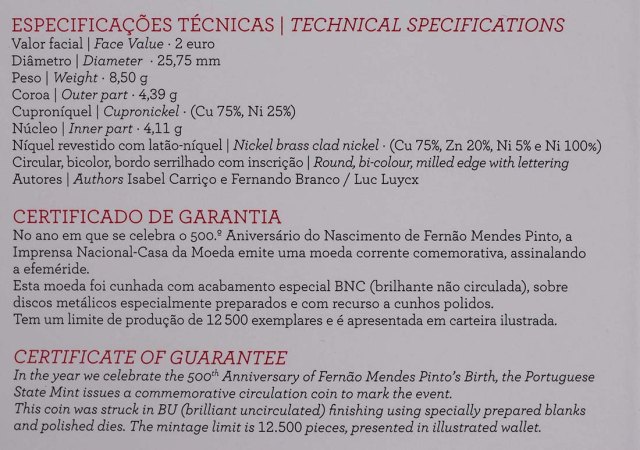
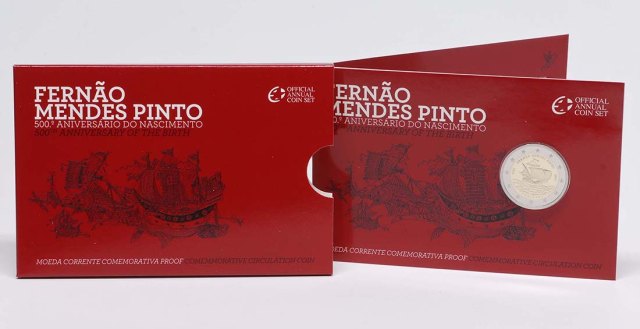
Blister pack BU: 12,497
Proof blister: 7,498
Official issue prices
2011 · Coincard: €9.50
2011 · Proof blister: €17.00