mintBisher wurden alle griechischen 2€CC geprägt bei:
Bank of Greece - Mint, Halandri
Issue occasion
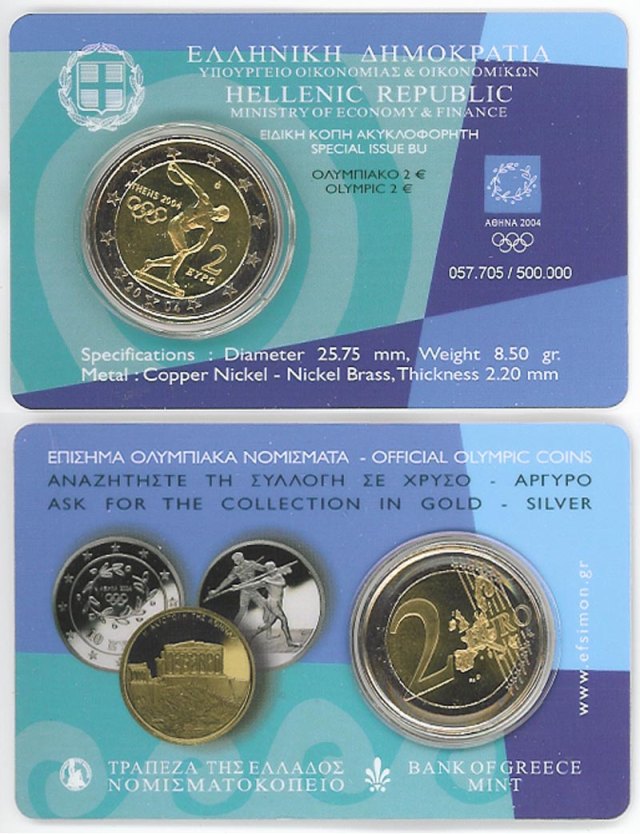
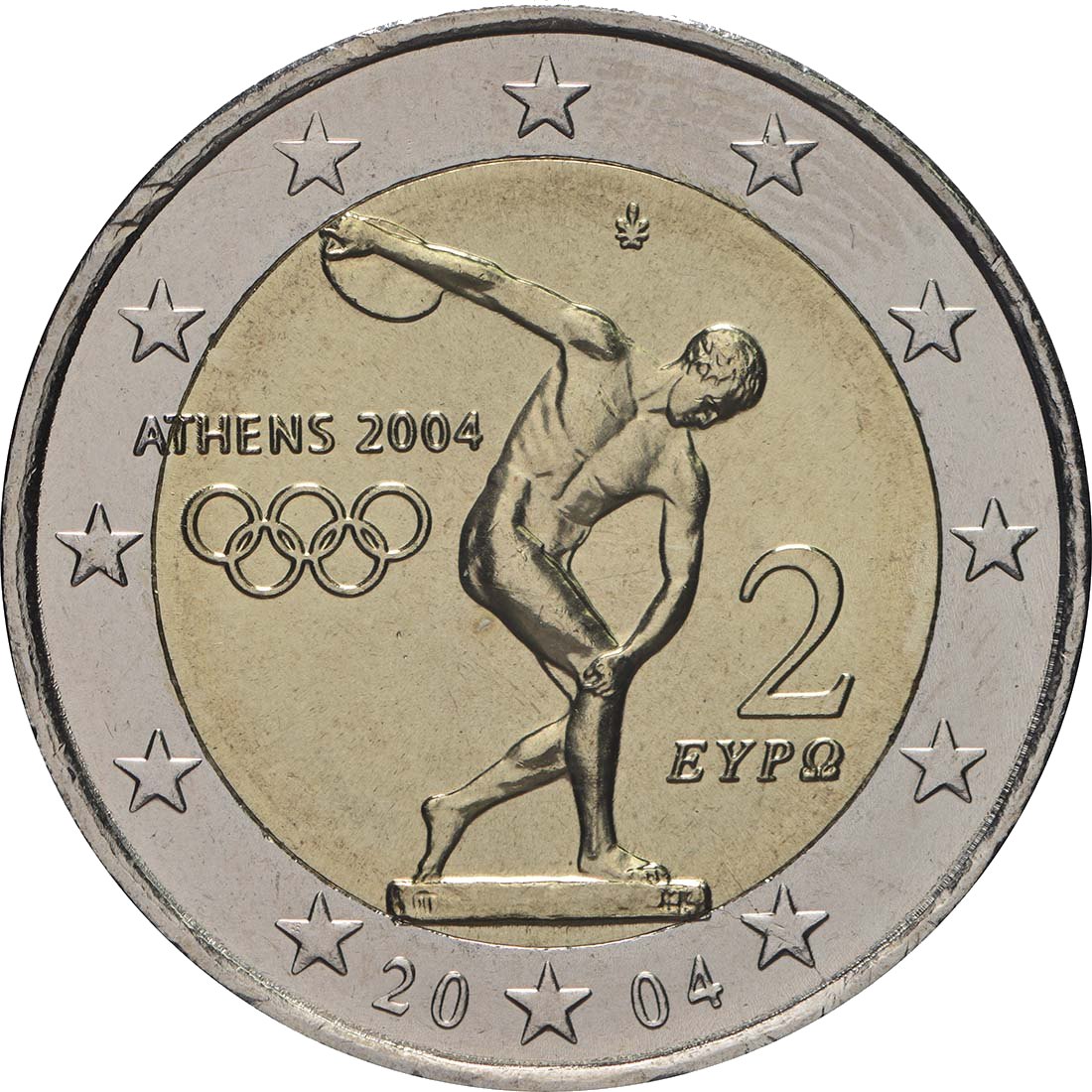
The commemorative coin honours the 2004 Olympic Games in Athens. The design features the ancient statue of a discus thrower, surrounded by the twelve stars of the European Union. On the left is the “ATHENS 2004” logo with the five Olympic rings; on the right, the number “2” and the word “ΕΥΡΩ” are arranged.
The design
The commemorative coin depicts the ancient statue of a discus thrower, surrounded by the twelve stars of the European Union. The statue’s pedestal covers a small part of the outer ring (outer part) of the coin. On the left is the logo of the Olympic Games “ATHEN 2004” with the five Olympic rings; on the right, the number “2” and the word “ΕΥΡΩ” are positioned one below the other. Next to the central star at the bottom, the year of minting is indicated in two separate groups of numbers: 20*04; the mintmark is located above the athlete’s head on the left.
Background on the topic
The Games of the XXVIII Olympiad took place from 13 to 29 August 2004. This made Athens the host city of the Olympic Summer Games for the second time after 1896. The 1896 Games are regarded as the beginning of the modern Olympic movement. Their organisation was attributable to the International Olympic Committee, founded in 1894, and in particular to the initiative of the Frenchman Pierre de Coubertin. Thus, 108 years lay between the two Athens editions.
The choice of Athens also established a connection with the ancient contests. These were held in Olympia on the Peloponnese in honour of the god Zeus. In addition to running and combat events, the ancient programme included the discus throw. The modern Olympic Games did not simply adopt the historical contests, but drew on the names, ceremonies and imagery of Greek antiquity. This includes the lighting of the Olympic flame in Olympia.
The discus thrower depicted refers to the “Discobolus”, a sculpture by the Greek sculptor Myron from the 5th century BC. The original work was presumably made of bronze and has not survived. The figure is known through Roman marble copies. It shows an athlete in the moment before the throw, with the body tensed in a controlled rotational movement. Since the revival of the Olympic Games, this depiction has frequently been used as a symbol of ancient sport.
Athens was awarded the 2004 Games as early as 1997. Competition venues and transport links, among other things, were newly built or renovated for the event. Individual competitions took place at historically significant locations: the Panathenaic Stadium, which had already been used in 1896, was the finish of the marathon.
The issue also had a numismatic significance. It was the first 2-euro commemorative coin after the euro states had authorised such nationally designed circulation coins. The occasion thus linked a globally prominent sporting event in the issuing country with Greece’s role in the ancient and modern history of the Olympic Games.
eBay price analysis
For this issue, there is a price history based on actual eBay sales – with median, range and number of sales
 Deutsch
 English
 Français
 Español
 Italiano
 Nederlands
 Português
 Slovenčina
 Hrvatski
 Slovenščina
 Lietuvių
 Eesti
Eesti Български