
 Deutsch
 English
 Français
 Español
 Italiano
 Nederlands
 Português
 Slovenčina
 Hrvatski
 Slovenščina
 Lietuvių
 Eesti
Eesti Български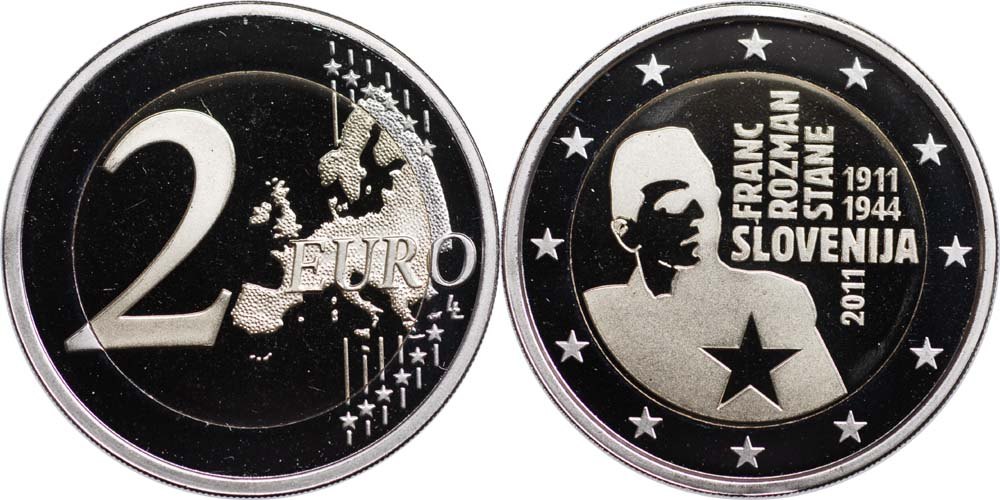
CC 94 2011
2 euro coin
Proof
2 Euro Proof
Slovenia · 100th birthday of Franc Rozman - Stane
Mintage10,000
Issue price€7.00
Issue date21 Mar 2011
Edge letteringSLOVENIJA •
Market price€17.00
Issue occasion
The commemorative coin commemorates the 100th birthday of the national hero Franc Rozman-Stane. The design features his portrait and a five-pointed star. It is complemented by the inscriptions “SLOVENIJA” and “FRANC ROZMAN STANE” as well as the years “1911”, “1944” and “2011”.
The design
The inner part of the coin features an image of Franc Rozman-Stane on the left and a five-pointed star below it in the center. The right side of the inner part of the coin is divided by the inscription “SLOVENJA”. The year “2011” is embossed vertically in the lower section. In the upper section, the words “FRANC”, “ROZMAN” and “STANE” are arranged vertically next to one another, with the years “1911” and “1944” arranged horizontally next to them.
The outer ring of the coin features the twelve stars of the flag of the European Union.
The outer ring of the coin features the twelve stars of the flag of the European Union.
Background on the topic
Franc Rozman, known by his partisan name “Stane”, came from a working-class family and trained as a baker. In the 1930s, he joined the communist movement. During the Spanish Civil War, he fought in the International Brigades on the side of the Republic against General Franco’s troops. There he gained military experience that later proved crucial to his role in the Slovenian resistance.
Following the Axis Powers’ attack on Yugoslavia in April 1941, the territory of present-day Slovenia was divided between Germany, Italy and Hungary. Occupation, coercive measures and policies of Germanization and Italianization led to the emergence of an organized resistance movement. The Slovenian Liberation Front played a central role, with the Communist Party increasingly assuming leadership. Its armed units became part of the Yugoslav partisan movement led by Josip Broz Tito. The struggle against the occupiers was also connected with a political upheaval that resulted in the emergence of socialist Yugoslavia after the end of the war.
Rozman held various command positions and ultimately headed the General Staff of the Slovenian partisan units. He died in November 1944 in an accident while testing a weapon. The year 1944 shown on the coin therefore refers to the year of his death and not to the end of the fighting in Slovenia.
After his death, Rozman was awarded the Yugoslav distinction “People’s Hero”. In the culture of remembrance of socialist Slovenia, he became one of the best-known figures of the partisan struggle; streets, schools and military facilities were named after him. In this context, the five-pointed star refers to the communist-led partisan movement. The coin issue commemorating the anniversary of his birth marked a milestone and drew on this state tradition of remembrance and on the role of the resistance in Slovenia’s history during the Second World War.
Following the Axis Powers’ attack on Yugoslavia in April 1941, the territory of present-day Slovenia was divided between Germany, Italy and Hungary. Occupation, coercive measures and policies of Germanization and Italianization led to the emergence of an organized resistance movement. The Slovenian Liberation Front played a central role, with the Communist Party increasingly assuming leadership. Its armed units became part of the Yugoslav partisan movement led by Josip Broz Tito. The struggle against the occupiers was also connected with a political upheaval that resulted in the emergence of socialist Yugoslavia after the end of the war.
Rozman held various command positions and ultimately headed the General Staff of the Slovenian partisan units. He died in November 1944 in an accident while testing a weapon. The year 1944 shown on the coin therefore refers to the year of his death and not to the end of the fighting in Slovenia.
After his death, Rozman was awarded the Yugoslav distinction “People’s Hero”. In the culture of remembrance of socialist Slovenia, he became one of the best-known figures of the partisan struggle; streets, schools and military facilities were named after him. In this context, the five-pointed star refers to the communist-led partisan movement. The coin issue commemorating the anniversary of his birth marked a milestone and drew on this state tradition of remembrance and on the role of the resistance in Slovenia’s history during the Second World War.
eBay price analysis
For this issue, there is a price history based on actual eBay sales – with median, range and number of sales
View price analysis