
 Deutsch
 English
 Français
 Español
 Italiano
 Nederlands
 Português
 Slovenčina
 Hrvatski
 Slovenščina
 Lietuvių
 Eesti
Eesti Български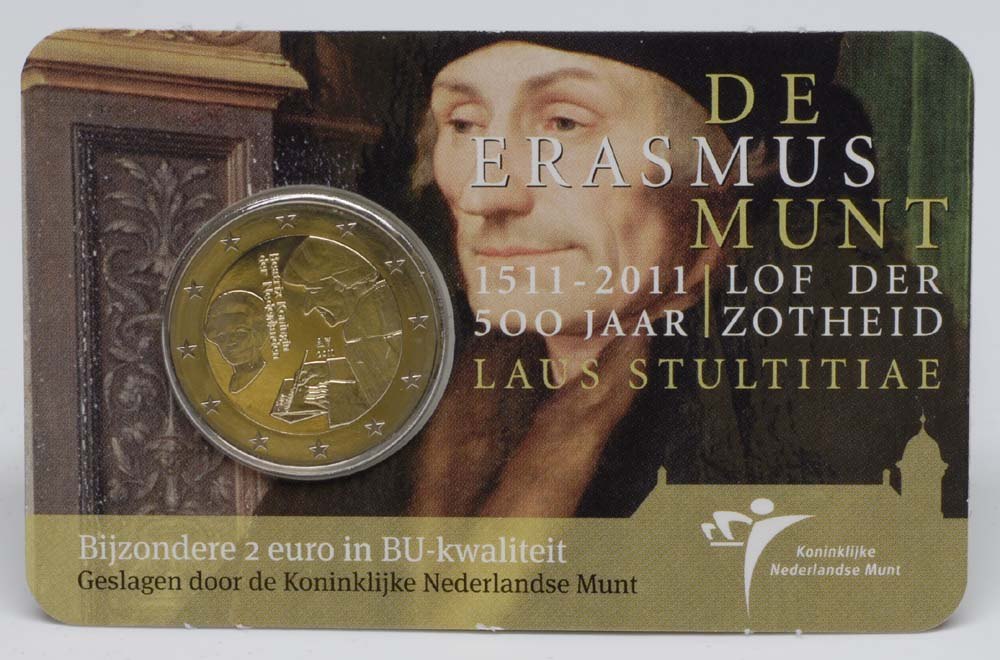
CC 90 2011
Coincard
BU
Coincard
Netherlands · Erasmus "Laus Stultitiae
Mintage10,000
Issue price€10.00
Issue date24 Jan 2011
PackagingCoincard
Edge letteringGOD ★ ZIJ ★ MET ★ ONS ★
Market price€59.00
Issue occasion
The commemorative coin commemorates the 500th anniversary of the publication of “Laus Stultitiae” (The Praise of Folly) by the Dutch philosopher, humanist and theologian Desiderus Erasmus. The design shows Erasmus writing the book, as well as a portrait of Queen Beatrix. Between them, the words “Beatrix Koningin der Nederlanden” appear vertically, alongside the year “2011” and the marks of the mint master and the mint.
The design
The inner part of the coin depicts Erasmus writing his book and the portrait of Queen Beatrix. Between these two images, the words “Beatrix Koningin der Nederlanden” are displayed vertically, alongside the year “2011” and the mint master’s mark and mint mark.
The twelve stars of the flag of the European Union are depicted on the coin’s outer ring.
The twelve stars of the flag of the European Union are depicted on the coin’s outer ring.
Background on the topic
Erasmus came from Rotterdam, but lived for extended periods in Paris, England, Leuven (Löwen), Basel and Freiburg im Breisgau, among other places. He was thus part of a Europe-wide network of scholars in which books, letters and ideas circulated across political and linguistic borders. He wrote predominantly in Latin, the common scholarly language of his time. In addition to his own writings, he published annotated editions of ancient authors and Christian texts. His edition of the Greek New Testament was intended to enable more precise study of the original sources.
In Praise of Folly (“Lob der Torheit”) was written during a stay in England and is dedicated to Erasmus’ friend Thomas Morus. The Latin title “Moriae encomium” also contains a play on his name. In the text, Folly appears as a person and delivers a speech in praise of herself. In doing so, she demonstrates the extent to which human behaviour is shaped by self-love, vanity, self-deception and social conventions.
The satire is directed against numerous groups, including scholars, princes, courtiers, members of religious orders, preachers and theologians. Erasmus is particularly critical of religious externals, empty scholarship and the misuse of ecclesiastical offices. The work is not, however, a simple attack on religion. Behind the mockery lies his conception of a Christianity that should be guided by personal piety, education and the example of Christ.
Erasmus criticised abuses in the Church but did not join the Reformation. He became involved in a public dispute with Martin Luther over the question of free will. His mediating position placed him between the confessional camps.
For the Netherlands, Erasmus provided an occasion that connects national origin with European intellectual history. His cross-border way of life, his Latin works and his impact in various countries also correspond to the European character of a euro circulation coin.
In Praise of Folly (“Lob der Torheit”) was written during a stay in England and is dedicated to Erasmus’ friend Thomas Morus. The Latin title “Moriae encomium” also contains a play on his name. In the text, Folly appears as a person and delivers a speech in praise of herself. In doing so, she demonstrates the extent to which human behaviour is shaped by self-love, vanity, self-deception and social conventions.
The satire is directed against numerous groups, including scholars, princes, courtiers, members of religious orders, preachers and theologians. Erasmus is particularly critical of religious externals, empty scholarship and the misuse of ecclesiastical offices. The work is not, however, a simple attack on religion. Behind the mockery lies his conception of a Christianity that should be guided by personal piety, education and the example of Christ.
Erasmus criticised abuses in the Church but did not join the Reformation. He became involved in a public dispute with Martin Luther over the question of free will. His mediating position placed him between the confessional camps.
For the Netherlands, Erasmus provided an occasion that connects national origin with European intellectual history. His cross-border way of life, his Latin works and his impact in various countries also correspond to the European character of a euro circulation coin.