
 Deutsch
 English
 Français
 Español
 Italiano
 Nederlands
 Português
 Slovenčina
 Hrvatski
 Slovenščina
 Lietuvių
 Eesti
Eesti Български
Reverse
2€no image yetObverse
2€no image yetMore images of the main coin
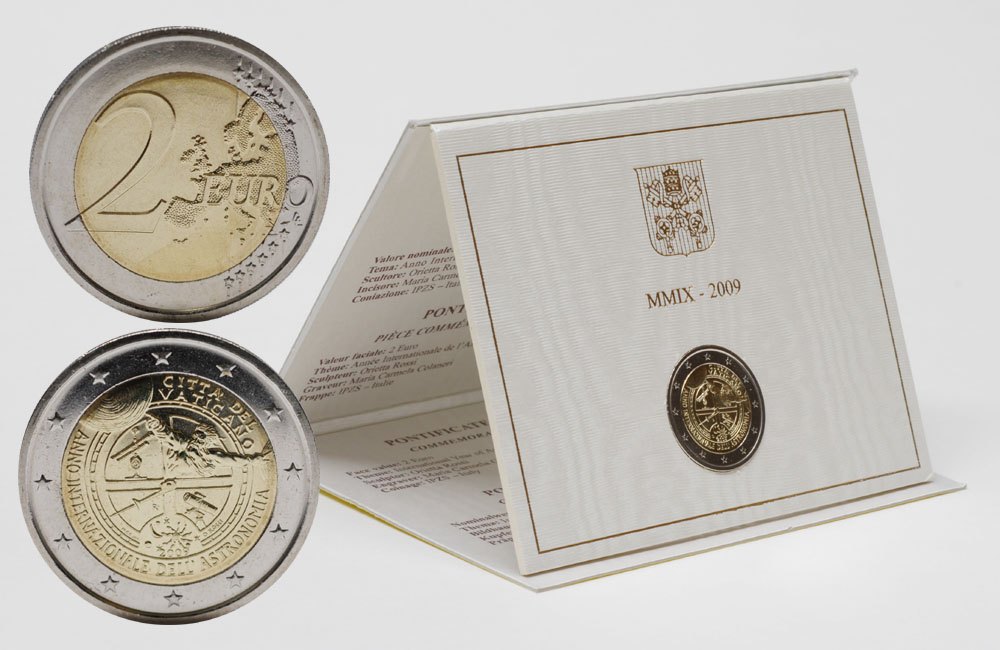
Vatican · International Year of Astronomy
Issue date18 Nov 2009
Total mintage106,084
EU maximum106,084
Editions3
Edge lettering2 ★ × 6, alternately upright/inverted
InscriptionR / 2009 / ANNO INTERNAZIONALE DELL’ASTRONOMIA / CITTÁ DEL VATICANO
DesignerOrietta Rossi (Maria Carmela Colaneri)
mintInstituto Poligrafico e Zecca Dello Stato, Roma
Issue occasion
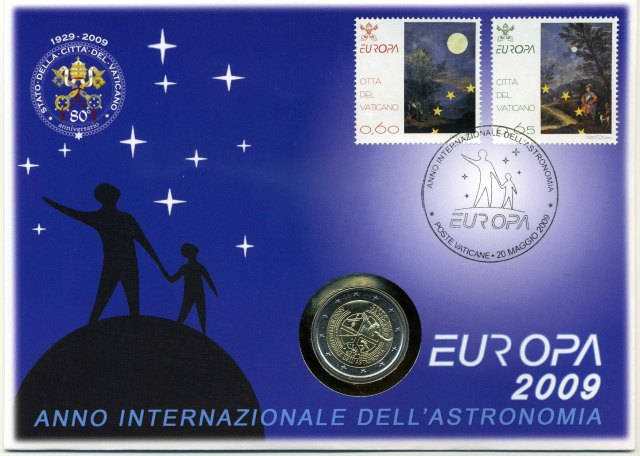
The commemorative coin is dedicated to the International Year of Astronomy. The design depicts an allegory of the birth of stars and planets, as well as several astronomical instruments, enclosed by the inscriptions “ANNO INTERNAZIONALE DELL’ASTRONOMIA” and “CITTÁ DEL VATICANO”.
The design
The inner part of the coin depicts an allegory of the birth of the stars and planets, as well as several astronomical instruments. The mintmark “R” is engraved in the lower-left quadrant. The year “2009” is centred below the two lower quadrants. The allegory is enclosed by an arc of a circle bearing the inscriptions “ANNO INTERNAZIONALE DELL’ASTRONOMIA” (in a semicircle offset to the left) and “CITTÁ DEL VATICANO” (at the top right). The twelve stars of the European flag are depicted on the coin’s outer ring.
Background on the topic
The International Year of Astronomy was proclaimed by the United Nations at the initiative of the International Astronomical Union and UNESCO. The point of reference was the beginning of telescopic observation of the sky by Galileo Galilei four hundred years earlier. In 1609, Galileo built his own telescopes and pointed them at the sky. Among other things, his observations revealed elevations and depressions on the Moon, numerous previously invisible stars, and several moons of Jupiter. This made it clear that not all celestial bodies orbit the Earth. The findings contributed to the acceptance of the heliocentric worldview.
Johannes Kepler’s work “Astronomia nova”, published in 1609, also belongs to the same historical context. In it, Kepler described planetary motion in terms of elliptical orbits and formulated two of the laws later named after him. Telescopic observation and mathematical description together transformed early modern astronomy.
The themed year was intended to impart astronomical knowledge, broaden access to observations of the sky, and promote international cooperation in research and education. Events, exhibitions, and observing programmes took place in numerous countries. Alongside the historical review, modern topics such as the development of stars and planetary systems and the position of the Earth in the universe were central.
The choice of the occasion by the Vatican is also connected with its own astronomical tradition. The calendar reform under Pope Gregory XIII, which led to the Gregorian calendar in 1582, required precise astronomical calculations. In 1891, Pope Leo XIII founded the Vatican Observatory in its present institutional form. It was intended to enable independent scientific research while also demonstrating that scientific knowledge and the Catholic faith need not fundamentally be understood as opposites. Because of Rome’s increasing light pollution, the observatory was later relocated to Castel Gandolfo; in addition, it works with a research institution in Arizona. Against this background, the themed year gave the Vatican a direct connection to a scientific institution that it has supported on a permanent basis.
Johannes Kepler’s work “Astronomia nova”, published in 1609, also belongs to the same historical context. In it, Kepler described planetary motion in terms of elliptical orbits and formulated two of the laws later named after him. Telescopic observation and mathematical description together transformed early modern astronomy.
The themed year was intended to impart astronomical knowledge, broaden access to observations of the sky, and promote international cooperation in research and education. Events, exhibitions, and observing programmes took place in numerous countries. Alongside the historical review, modern topics such as the development of stars and planetary systems and the position of the Earth in the universe were central.
The choice of the occasion by the Vatican is also connected with its own astronomical tradition. The calendar reform under Pope Gregory XIII, which led to the Gregorian calendar in 1582, required precise astronomical calculations. In 1891, Pope Leo XIII founded the Vatican Observatory in its present institutional form. It was intended to enable independent scientific research while also demonstrating that scientific knowledge and the Catholic faith need not fundamentally be understood as opposites. Because of Rome’s increasing light pollution, the observatory was later relocated to Castel Gandolfo; in addition, it works with a research institution in Arizona. Against this background, the themed year gave the Vatican a direct connection to a scientific institution that it has supported on a permanent basis.
eBay price analysis
For this issue, there is a price history based on actual eBay sales – with median, range and number of sales
View price analysisBlister pack BU – Single page
- Packaging
- Blister pack
- Mintage
- 85,000
- Market price
- €69.00
- Edge lettering
- 2 ★ × 6, alternately upright/inverted
Mintage by issue type
BU
91,084
2 Editions
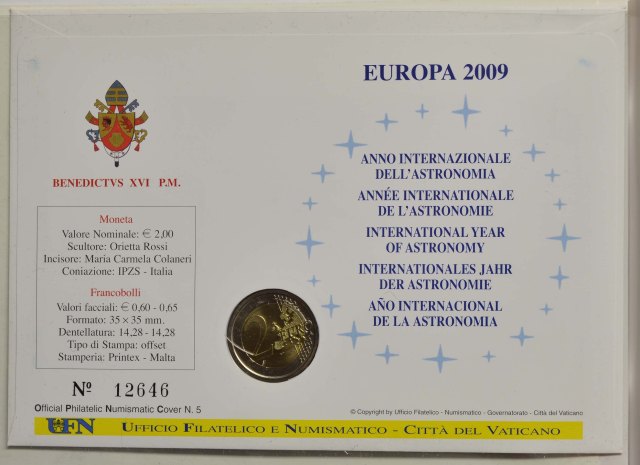
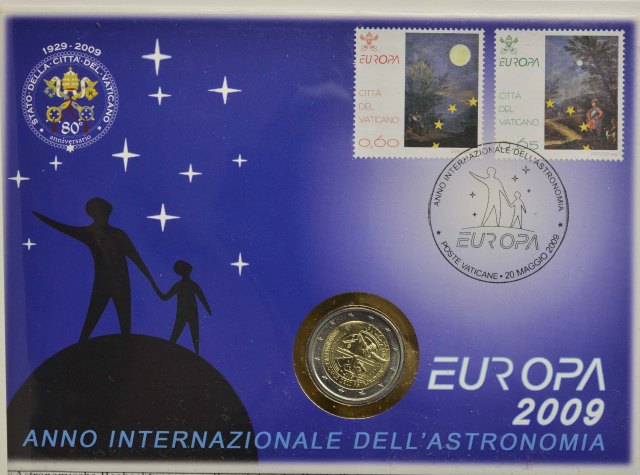
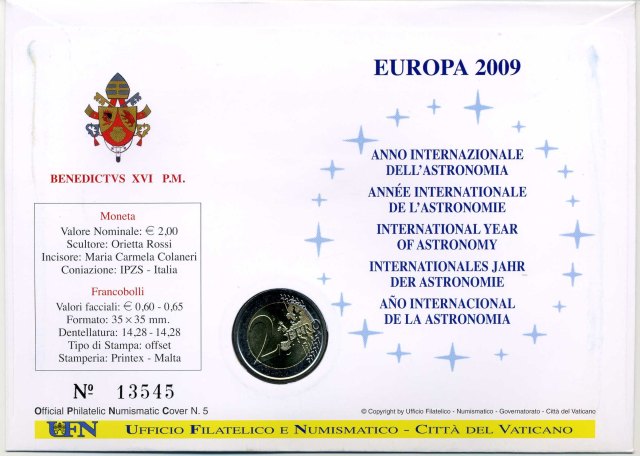
Numismatic cover
15,000
More editions
2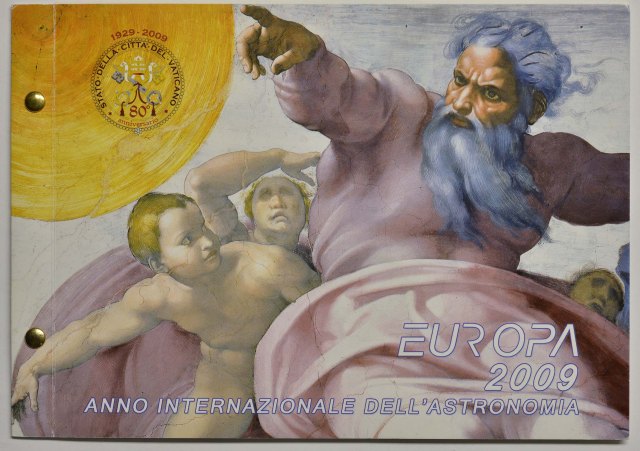
Issue date
218 Nov 2009 · Vatikan – Intern. Jahr der Astronomie
2 Euro Stgl./BU
18 Nov 2009 · Vatikan – Intern. Jahr der Astronomie
Blister BU
Mintages
Vatikan
106,084Circulation: 6,084
Blister pack BU: 85,000
Numismatic cover: 15,000
Official issue prices
2009 · Blister pack BU: €14.00
2009 · Numismatic cover: €45.00
Additional information
Entgegen älteren anderslautenden Infos sollen von dieser Münze doch nicht einige Exemplare in Normalprägung für den Zahlungsverkehr an Vatikan-Mitarbeiter ausgegeben worden sein, sondern alle Münzen in der Blisterverpackung erschienen sein.