
 Deutsch
 English
 Français
 Español
 Italiano
 Nederlands
 Português
 Slovenčina
 Hrvatski
 Slovenščina
 Lietuvių
 Eesti
Eesti Български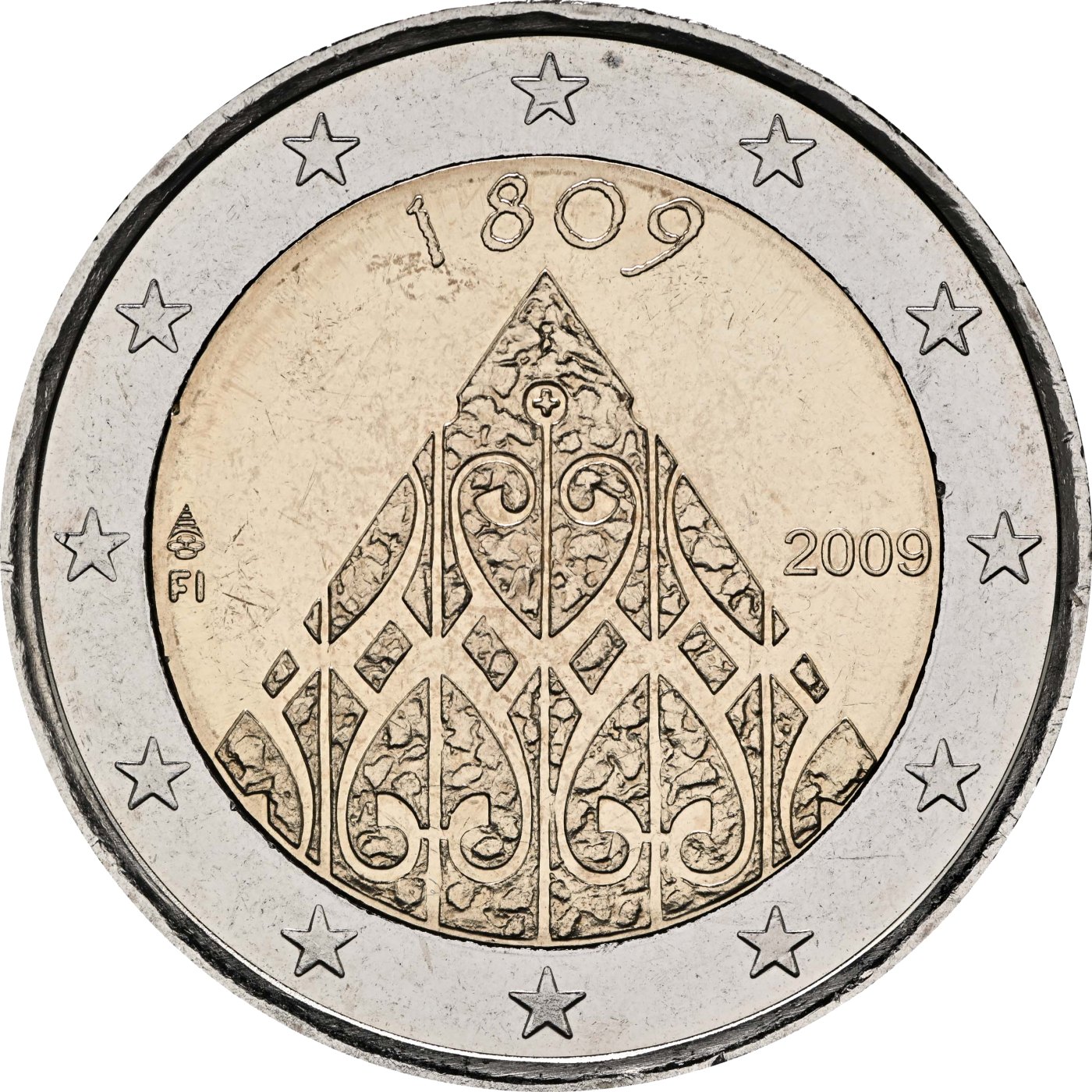
CC 74 2009
2 euro coin
BU Main coin Bank issue
2 Euro BU
Finland · 200 years of Finnish Autonomy
Mintage1,555,000
Issue date23 Oct 2009
Edge letteringSUOMI FINLAND + 3 lion heads
Market price€15.90
Issue occasion
The coin commemorates the 200th anniversary of the first Finnish Diet and the establishment of central state institutions in Finland. The design features the silhouette of Porvoo Cathedral, where the first Finnish Diet was constituted, as well as the years 1809 and 2009. To the left are the country code “FI” and the mint mark.
The design
The inner part of the coin shows the silhouette of Porvoo Cathedral, where the first Finnish Diet was constituted. The date 1809 is engraved above it. The year 2009 appears on the right-hand side. The issuing country “FI” and the mint mark are engraved on the left. The twelve stars of the European flag are depicted on the outer ring of the coin.
Background on the topic
The Diet of Porvoo was connected with the Finnish War of 1808 to 1809. In the course of this war, the Russian Empire occupied the Finnish territories that had until then belonged to the Kingdom of Sweden. The final transfer to Russia was sealed by the Treaty of Fredrikshamn. Finland was subsequently incorporated into the Russian Empire as a Grand Duchy; the Russian emperor and the Finnish Grand Duke were the same person.
Even before the conclusion of peace, Emperor Alexander I convened the representatives of the four estates of the time: the nobility, the clergy, the burghers and the peasantry. This assembly of the estates was not a parliament in the modern democratic sense. The population was not represented on the basis of universal and equal suffrage, and political participation rights were divided according to social groups. Representatives of the Finnish territories had previously participated in the Swedish Diet; the assembly of 1809 now created a separate political framework for Finland.
Alexander I promised to respect the existing religion as well as the country’s traditional laws and rights. The estates, for their part, swore an oath of allegiance to him. These mutual declarations gave rise to the idea of a special Finnish legal and administrative order within the Russian Empire. The extent to which these promises constituted a formal constitution was interpreted differently at a later date.
As a result, a separate central administration was established. A governing council assumed responsibility for internal administration and was later referred to as the Senate. Finland also retained its own laws, its own administration and separate state finances. This institutional autonomy contributed to the emergence of a Finnish state in the 19th century, although the country continued to belong to the Russian Empire.
The coin’s theme thus refers to a political turning point: not only did Finland’s state affiliation change, but institutions also emerged that could serve as a basis for later parliamentary and state structures. The anniversary therefore provided an occasion to commemorate the formative period of the autonomous Grand Duchy.
Even before the conclusion of peace, Emperor Alexander I convened the representatives of the four estates of the time: the nobility, the clergy, the burghers and the peasantry. This assembly of the estates was not a parliament in the modern democratic sense. The population was not represented on the basis of universal and equal suffrage, and political participation rights were divided according to social groups. Representatives of the Finnish territories had previously participated in the Swedish Diet; the assembly of 1809 now created a separate political framework for Finland.
Alexander I promised to respect the existing religion as well as the country’s traditional laws and rights. The estates, for their part, swore an oath of allegiance to him. These mutual declarations gave rise to the idea of a special Finnish legal and administrative order within the Russian Empire. The extent to which these promises constituted a formal constitution was interpreted differently at a later date.
As a result, a separate central administration was established. A governing council assumed responsibility for internal administration and was later referred to as the Senate. Finland also retained its own laws, its own administration and separate state finances. This institutional autonomy contributed to the emergence of a Finnish state in the 19th century, although the country continued to belong to the Russian Empire.
The coin’s theme thus refers to a political turning point: not only did Finland’s state affiliation change, but institutions also emerged that could serve as a basis for later parliamentary and state structures. The anniversary therefore provided an occasion to commemorate the formative period of the autonomous Grand Duchy.
eBay price analysis
For this issue, there is a price history based on actual eBay sales – with median, range and number of sales
View price analysis