
 Deutsch
 English
 Français
 Español
 Italiano
 Nederlands
 Português
 Slovenčina
 Hrvatski
 Slovenščina
 Lietuvių
 Eesti
Eesti Български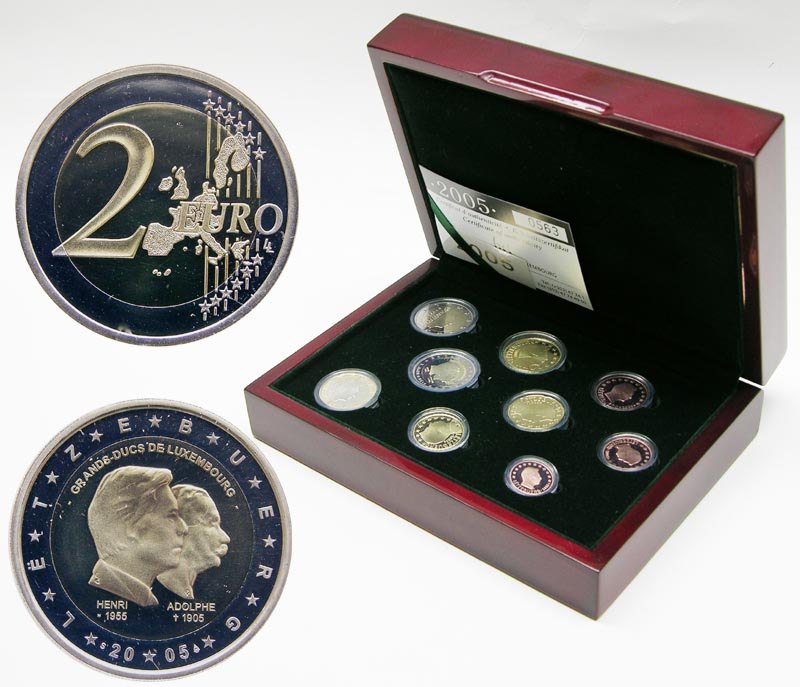
CC 7 2005
Coin set
Proof Mint mark SUOMEN RAHAPAJA
Coin set proof
Luxembourg · Grand Dukes Henri and Adolphe
Mintage1,500
Issue price€75.00
Issue date8 Feb 2005
PackagingCoin set
Edge lettering2 ★ ★ × 6, alternating upright/inverted
Market price€259.00
Issue occasion
The commemorative coin honours the 50th birthday of Grand Duke Henri, the fifth anniversary of his accession to office and the 100th anniversary of the death of Grand Duke Adolphe. The design depicts the head portraits of Grand Duke Henri and Grand Duke Adolphe facing right, complemented by the inscriptions “GRANDS-DUCS DE LUXEMBOURG”, “HENRI * 1955” and “ADOLPHE + 1905”. Twelve stars are arranged between the letters of the word “LËTZEBUERG”.
The design
The inner part of the coin shows, on the left, the portrait of His Royal Highness Grand Duke Henri facing right, positioned above and offset from the portrait of former Grand Duke Adolphe on the right. Above the portraits, the inscription “GRANDS-DUCS DE LUXEMBOURG” is arranged in a semicircle. Beneath the respective portraits are the inscriptions “HENRI * 1955 ADOLPHE + 1905”. The coin design is surrounded on the outer ring by 12 stars, positioned between the letters of the word “LËTZEBUERG”. The year of mintage 2005 is located at the bottom of the coin between the mint logo and the letter “S”.
Background on the topic
Grand Duke Adolphe was initially Duke of Nassau. This duchy was annexed by Prussia in 1866 after the Austro-Prussian War (Deutscher Krieg), as Adolphe had sided with Austria. His rule in Luxembourg began in 1890 after the death of the Dutch king and Luxembourg Grand Duke Wilhelm III. Until then, the Netherlands and Luxembourg had been linked by a personal union: both states had the same monarch but remained legally independent.
The personal union ended because of different succession rules. In the Netherlands, Wilhelmina, the daughter of Wilhelm III, was able to assume the throne. In Luxembourg, however, the Nassauischer Erbverein applied, under which the crown at that time passed to a male member of the House of Nassau. Adolphe thus became Grand Duke. With him began the Luxembourg ruling line of the House of Nassau-Weilburg, which continues to this day. During his reign, he largely left the ongoing affairs of government to Luxembourg’s political institutions.
Henri is a great-great-grandson of Adolphe. He succeeded his father, Grand Duke Jean, to the throne after his abdication in 2000. Luxembourg is a parliamentary monarchy. The Grand Duke is the head of state, while political responsibility lies with the elected Chamber of Deputies and the government. His duties primarily include representing the state, as well as constitutionally defined functions in the formation of the government and the legislative process.
The depiction of both rulers together links the present-day monarchy with the transition from the Dutch-Luxembourgish personal union to Luxembourg’s own dynasty. Adolphe thus represents the dynastic new beginning of 1890, while Henri represents the continuation of this line today. The temporal overlap of several personal and national anniversaries provided the immediate occasion for depicting both of them together on one coin. At the same time, the portrait of the ruler follows the Luxembourg tradition of depicting the head of state on the national sides of euro coins.
The personal union ended because of different succession rules. In the Netherlands, Wilhelmina, the daughter of Wilhelm III, was able to assume the throne. In Luxembourg, however, the Nassauischer Erbverein applied, under which the crown at that time passed to a male member of the House of Nassau. Adolphe thus became Grand Duke. With him began the Luxembourg ruling line of the House of Nassau-Weilburg, which continues to this day. During his reign, he largely left the ongoing affairs of government to Luxembourg’s political institutions.
Henri is a great-great-grandson of Adolphe. He succeeded his father, Grand Duke Jean, to the throne after his abdication in 2000. Luxembourg is a parliamentary monarchy. The Grand Duke is the head of state, while political responsibility lies with the elected Chamber of Deputies and the government. His duties primarily include representing the state, as well as constitutionally defined functions in the formation of the government and the legislative process.
The depiction of both rulers together links the present-day monarchy with the transition from the Dutch-Luxembourgish personal union to Luxembourg’s own dynasty. Adolphe thus represents the dynastic new beginning of 1890, while Henri represents the continuation of this line today. The temporal overlap of several personal and national anniversaries provided the immediate occasion for depicting both of them together on one coin. At the same time, the portrait of the ruler follows the Luxembourg tradition of depicting the head of state on the national sides of euro coins.
Interesting Facts
This coin set contains all eight circulation coins from 1 cent to 2 euros, as well as this €2 commemorative coin (face value: €5.88).