
 Deutsch
 English
 Français
 Español
 Italiano
 Nederlands
 Português
 Slovenčina
 Hrvatski
 Slovenščina
 Lietuvių
 Eesti
Eesti Български
Reverse

Obverse

Portugal · 60th anniversary of human rights
Issue date18 Sept 2008
Total mintage1,016,261
EU maximum1,035,000
Editions3
Edge lettering5 Wappenschilde + 7 castles, evenly distributed
InscriptionPORTUGAL / 2008 / 60 ANOS DA DECLARAÇÃO UNIVERSAL DOS DIREITOS HUMANOS / Esc. J. Duarte INCM
DesignerJoão Duarte
mintImprensa Nacional Casa da Moeda S.A., Lisboa
Issue occasion
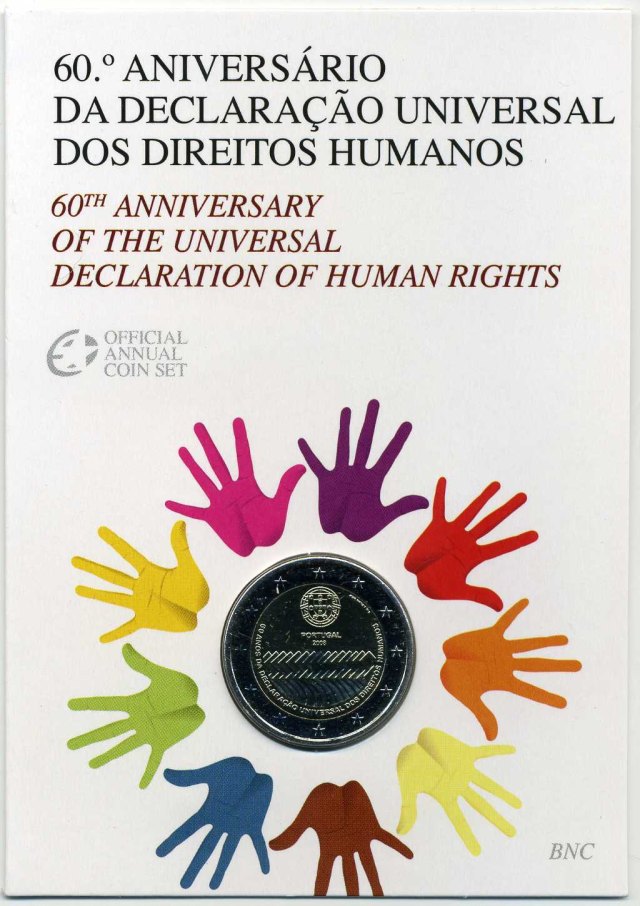
The commemorative coin commemorates the 60th anniversary of the adoption of the Universal Declaration of Human Rights (Allgemeine Erklärung der Menschenrechte). The design depicts the Portuguese coat of arms above the inscription “PORTUGAL” and the year “2008”, as well as a geometric representation in the lower half. Along the lower edge is the inscription “60 ANOS DA DECLARAÇÃO UNIVERSAL DOS DIREITOS HUMANOS”; the twelve stars of the European flag are depicted on the outer ring.
The design
The inner part of the coin shows the Portuguese coat of arms in the centre of the upper edge, with the name of the issuing country (“PORTUGAL”) below it and the year “2008” beneath that. The lower half of the inner part of the coin is filled by a geometric design. Along two thirds of the lower edge of the inner part of the coin runs the text “60 ANOS DA DECLARAÇÃO UNIVERSAL DOS DIREITOS HUMANOS”, followed by “Esc. J. Duarte INCM” in very small lettering. The twelve stars of the European flag are depicted on the outer ring of the coin.
Background on the topic
The Universal Declaration of Human Rights was created in response to the experiences of the Second World War, the National Socialist policy of persecution and extermination, and the mass deprivation of people's rights. It was intended to formulate principles that apply to all people, regardless of nationality, origin, sex, religion or political conviction. The General Assembly of the United Nations adopted it in Paris on 10 December 1948.
Representatives of different states and legal traditions were involved in its drafting. The relevant UN Commission on Human Rights was chaired by Eleanor Roosevelt, the widow of US President Franklin D. Roosevelt. Other influential participants included the French jurist René Cassin, the Canadian jurist John Peters Humphrey, the Chinese diplomat Peng-chun Chang and the Lebanese philosopher and diplomat Charles Malik. The text was therefore not the work of a single person.
The Declaration comprises 30 articles. In addition to the right to life, liberty and security, it sets out, among other things, the prohibition of slavery and torture, equality before the law, freedom of religion and opinion, as well as political, social and economic rights. These include the rights to work, education and social security. The Declaration is not itself a treaty under international law. However, it became a reference point for subsequent binding human rights agreements, national constitutions and international courts.
For Portugal, the subject also has a domestic political dimension. Following the end of the authoritarian dictatorship through the Carnation Revolution (Nelkenrevolution) of 1974, the protection of fundamental rights became a core element of the democratic order. The Portuguese Constitution of 1976 contains a detailed catalogue of personal, political, economic and social rights.
The milestone anniversary was commemorated worldwide in 2008 by the United Nations and numerous states. The coin issue placed Portugal within this international commemoration and linked a global human rights document with its own democratic development.
Representatives of different states and legal traditions were involved in its drafting. The relevant UN Commission on Human Rights was chaired by Eleanor Roosevelt, the widow of US President Franklin D. Roosevelt. Other influential participants included the French jurist René Cassin, the Canadian jurist John Peters Humphrey, the Chinese diplomat Peng-chun Chang and the Lebanese philosopher and diplomat Charles Malik. The text was therefore not the work of a single person.
The Declaration comprises 30 articles. In addition to the right to life, liberty and security, it sets out, among other things, the prohibition of slavery and torture, equality before the law, freedom of religion and opinion, as well as political, social and economic rights. These include the rights to work, education and social security. The Declaration is not itself a treaty under international law. However, it became a reference point for subsequent binding human rights agreements, national constitutions and international courts.
For Portugal, the subject also has a domestic political dimension. Following the end of the authoritarian dictatorship through the Carnation Revolution (Nelkenrevolution) of 1974, the protection of fundamental rights became a core element of the democratic order. The Portuguese Constitution of 1976 contains a detailed catalogue of personal, political, economic and social rights.
The milestone anniversary was commemorated worldwide in 2008 by the United Nations and numerous states. The coin issue placed Portugal within this international commemoration and linked a global human rights document with its own democratic development.
eBay price analysis
For this issue, there is a price history based on actual eBay sales – with median, range and number of sales
View price analysis2 Euro BU – Single page
- Mintage
- 1,000,000
- Market price
- €3.90
- Edge lettering
- 5 Wappenschilde + 7 castles, evenly distributed
Mintage by issue type
BU
1,000,000
Blister pack
16,261
2 Editions
More editions
2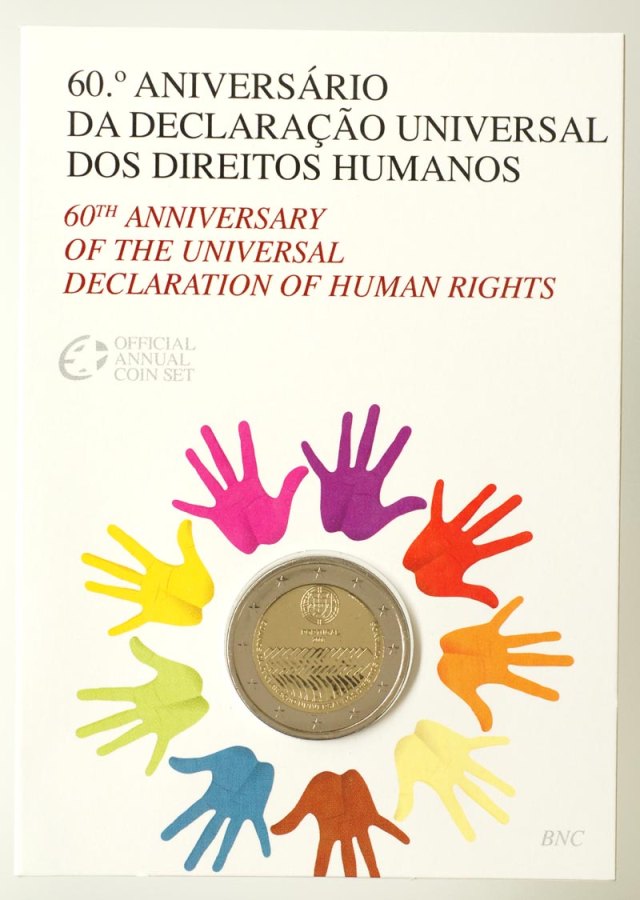


Mintages
Portugal
1,016,261Circulation: 1,000,000
Blister pack BU: 8,039
Proof blister: 8,222
Official issue prices
2008 · Coincard: €9.00
2008 · Proof blister: €16.00
Additional information
Die normale Kursmünze 2008 wurde dieses Jahr nicht geprägt.