
 Deutsch
 English
 Français
 Español
 Italiano
 Nederlands
 Português
 Slovenčina
 Hrvatski
 Slovenščina
 Lietuvių
 Eesti
Eesti Български


CC 456 2022
2 euro coin
Proof Mint mark Mincovna Kremnica
2 Euro Proof (6th Proof Set 2022-2023)
Luxembourg · 35 years of the Erasmus Programme
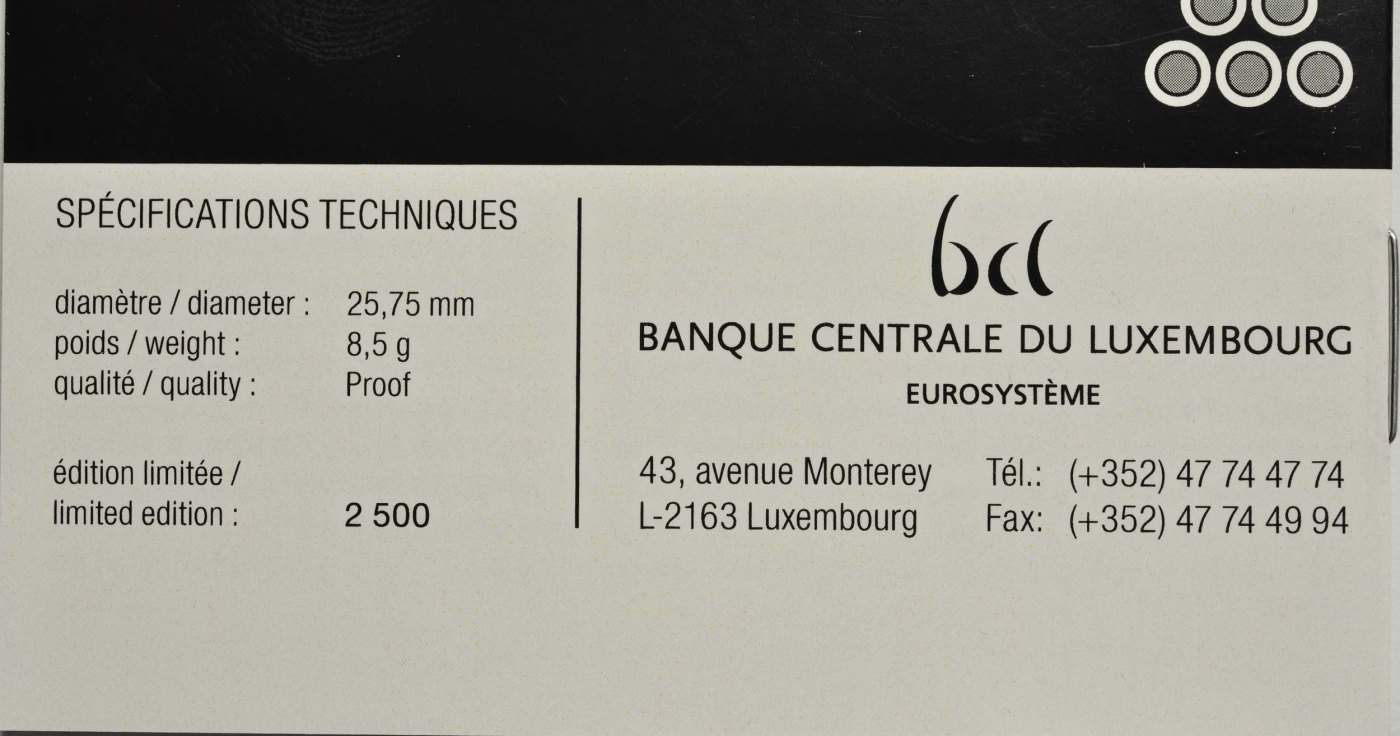
Mintage2,500
Issue date1 Jul 2022
Packaging6. Proof set 2022-2023
Edge lettering2 ★ ★ × 6, alternating upright/inverted
Price of the set (5 coins)€599.00
Issue occasion
The commemorative coin marks 35 years of the Erasmus programme. The design combines a well-known depiction of Erasmus with a ray of connections between beacons, symbolising the intellectual and human exchange of European students. Some of the connections form stars, from which the anniversary number 35 emerges.
The design
The coin design features a combination of two key elements of the Erasmus programme: its original intellectual inspiration, Erasmus himself, and an allegory of his influence on Europe.
The former is symbolised by one of the best-known depictions of Erasmus.
The latter is represented by a network of connections extending from one beacon to another across the coin, depicting the diverse intellectual and human exchange between European students.
With regard to Europe, some of these connections form stars emerging from the synergies between the countries.
The anniversary number 35 emerges from the stars in a contemporary graphic style.
The twelve stars of the European flag are depicted on the coin’s outer ring.
The former is symbolised by one of the best-known depictions of Erasmus.
The latter is represented by a network of connections extending from one beacon to another across the coin, depicting the diverse intellectual and human exchange between European students.
With regard to Europe, some of these connections form stars emerging from the synergies between the countries.
The anniversary number 35 emerges from the stars in a contemporary graphic style.
The twelve stars of the European flag are depicted on the coin’s outer ring.
Background on the topic
The programme is named after Desiderius Erasmus von Rotterdam, a Dutch humanist, theologian and Renaissance philologist. He was born in the 15th century and died in Basel in 1536. Erasmus spent time studying and working, among other places, in Paris, England, Italy, Leuven, Freiburg and Basel. Through travel, personal encounters and extensive correspondence, he was part of a Europe-wide network of scholars. One of his best-known writings is the satire “Lob der Torheit”. He also published a Greek edition of the New Testament with a Latin translation in 1516. Although he criticised abuses in the Church and society, he did not join the Reformation.
The exchange programme named after him was established by the European Community of the time in 1987. The name “ERASMUS” was also used as an abbreviation for “European Region Action Scheme for the Mobility of University Students”. The programme was intended to facilitate periods of study in other European countries. This included financial grants, agreements between higher education institutions and procedures for recognising academic achievements completed abroad. In this way, a semester abroad was not supposed to lead to an unnecessary extension of the course of study.
Over time, Erasmus was extended to other areas of education and groups of participants. Since 2014, it has been part of Erasmus+, the EU programme for education, vocational training, youth and sport. In addition to students, trainees, teachers, higher education staff and young people, among others, can participate in supported exchange and cooperation projects.
The anniversary was suitable for a joint coin issue because Erasmus is not a national institution of any individual state, but is based on cross-border cooperation. The fact that numerous euro-area countries used the same basic design reflected this European character. The design was also not determined solely administratively: following a design competition and a preselection by a panel of experts, citizens of the European Union decided on the design in an online vote.
The exchange programme named after him was established by the European Community of the time in 1987. The name “ERASMUS” was also used as an abbreviation for “European Region Action Scheme for the Mobility of University Students”. The programme was intended to facilitate periods of study in other European countries. This included financial grants, agreements between higher education institutions and procedures for recognising academic achievements completed abroad. In this way, a semester abroad was not supposed to lead to an unnecessary extension of the course of study.
Over time, Erasmus was extended to other areas of education and groups of participants. Since 2014, it has been part of Erasmus+, the EU programme for education, vocational training, youth and sport. In addition to students, trainees, teachers, higher education staff and young people, among others, can participate in supported exchange and cooperation projects.
The anniversary was suitable for a joint coin issue because Erasmus is not a national institution of any individual state, but is based on cross-border cooperation. The fact that numerous euro-area countries used the same basic design reflected this European character. The design was also not determined solely administratively: following a design competition and a preselection by a panel of experts, citizens of the European Union decided on the design in an online vote.
eBay price analysis
For this issue, there is a price history based on actual eBay sales – with median, range and number of sales
View price analysis