
 Deutsch
 English
 Français
 Español
 Italiano
 Nederlands
 Português
 Slovenčina
 Hrvatski
 Slovenščina
 Lietuvių
 Eesti
Eesti Български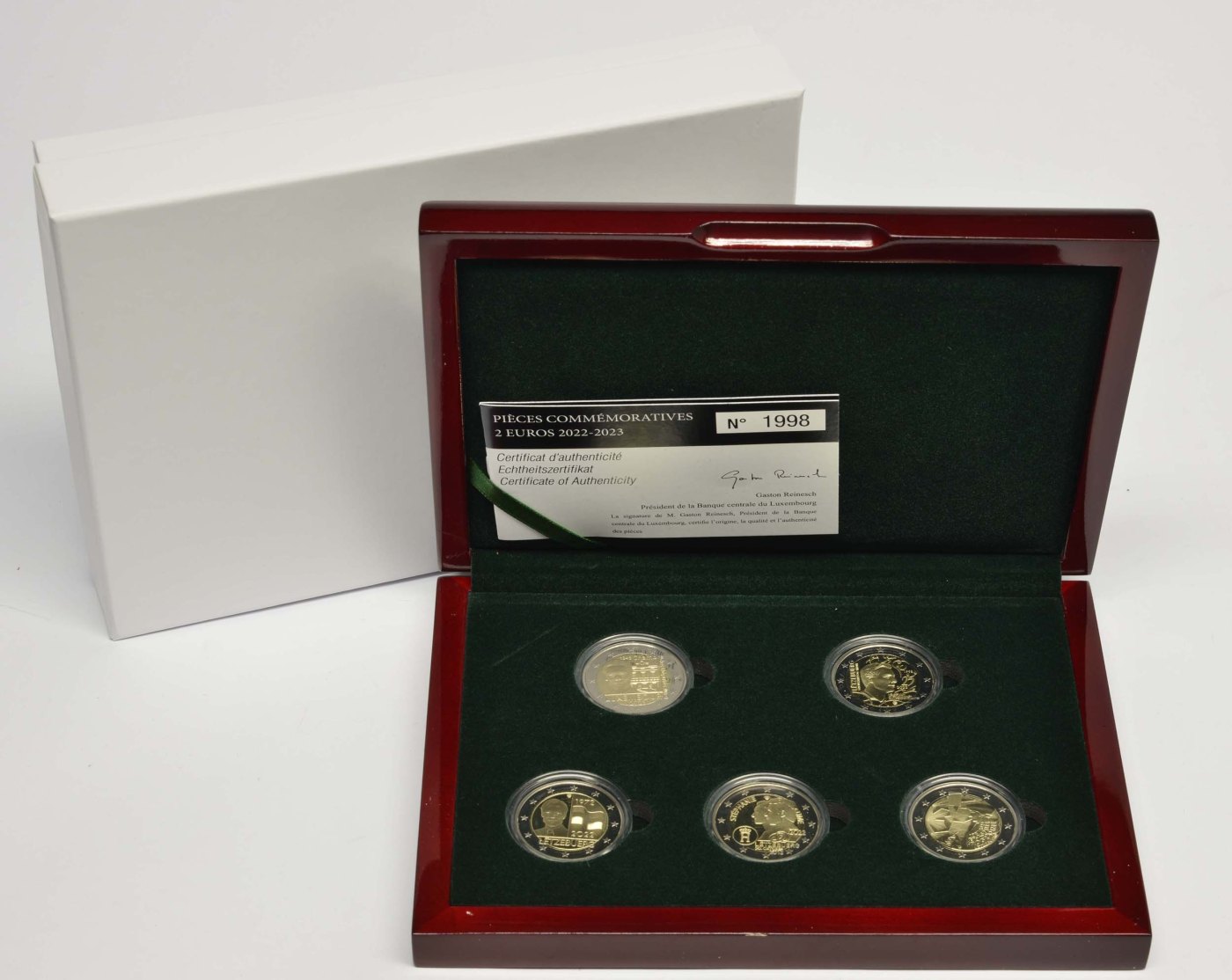
CC 444 2022
2 euro coin
Proof Mint mark Mincovna Kremnica
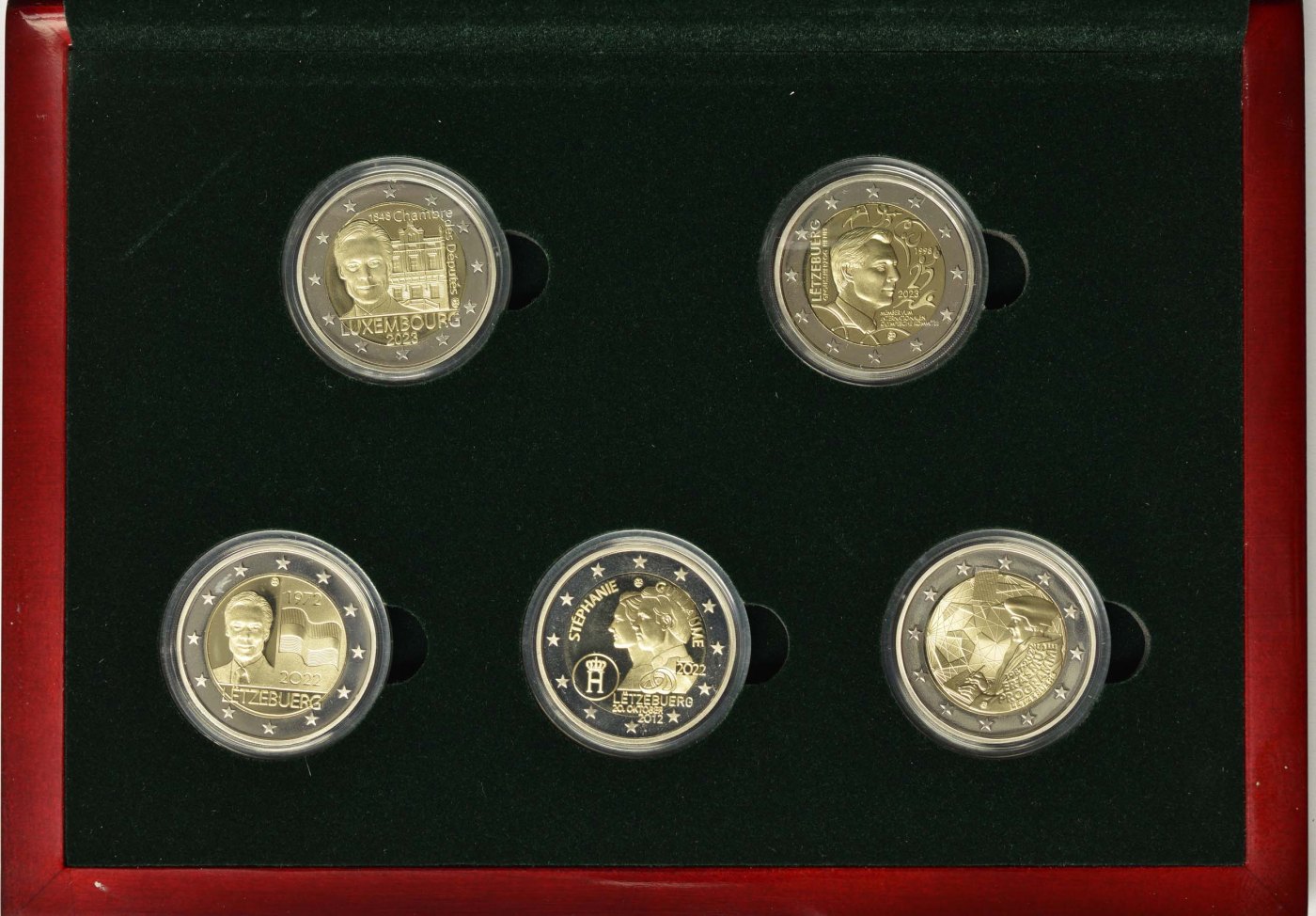
2 Euro Proof (6th Proof Set 2022-2023)
Luxembourg · 50 years of legal protection of the Luxembourg flag
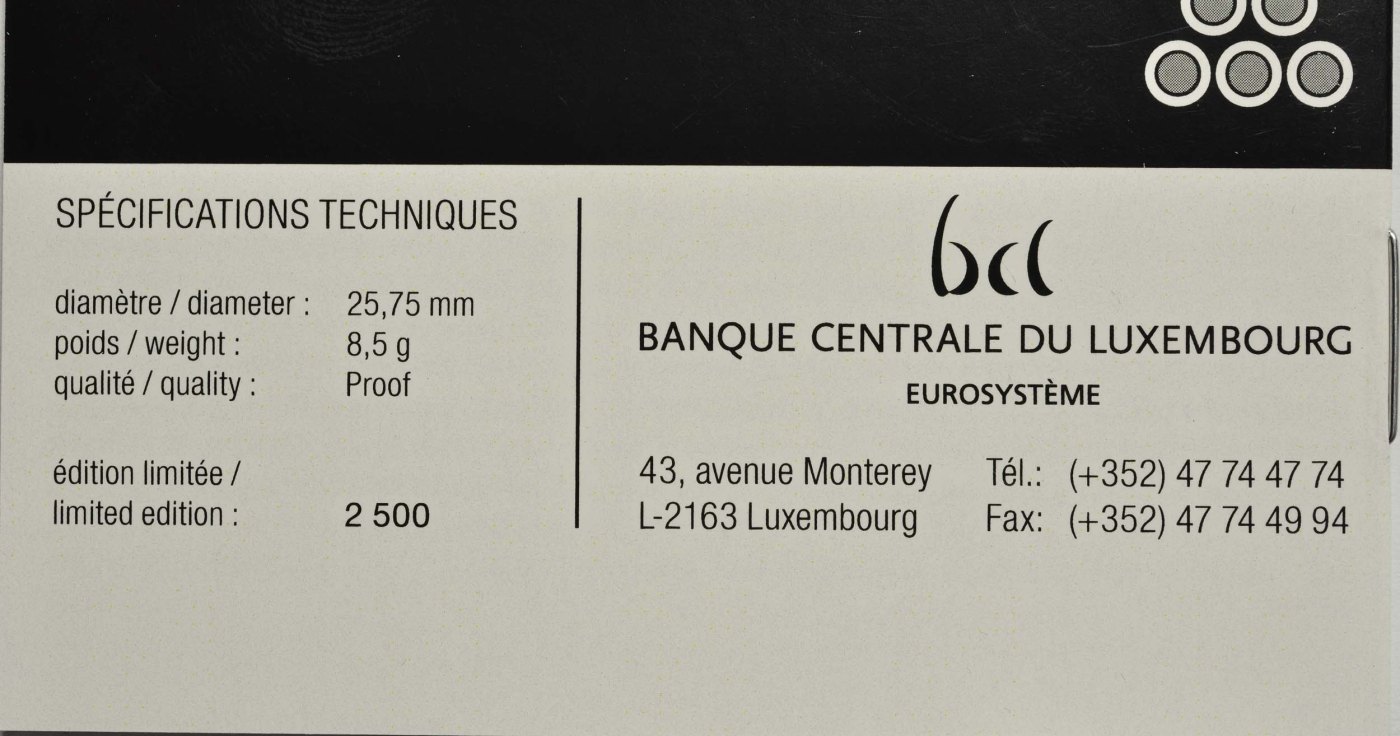
Mintage2,500
Issue price€99.00
Issue date1 Jul 2022
Packaging6. Proof set 2022-2023
Edge lettering2 ★ ★ × 6, alternating upright/inverted
Price of the set (5 coins)€599.00
Issue occasion
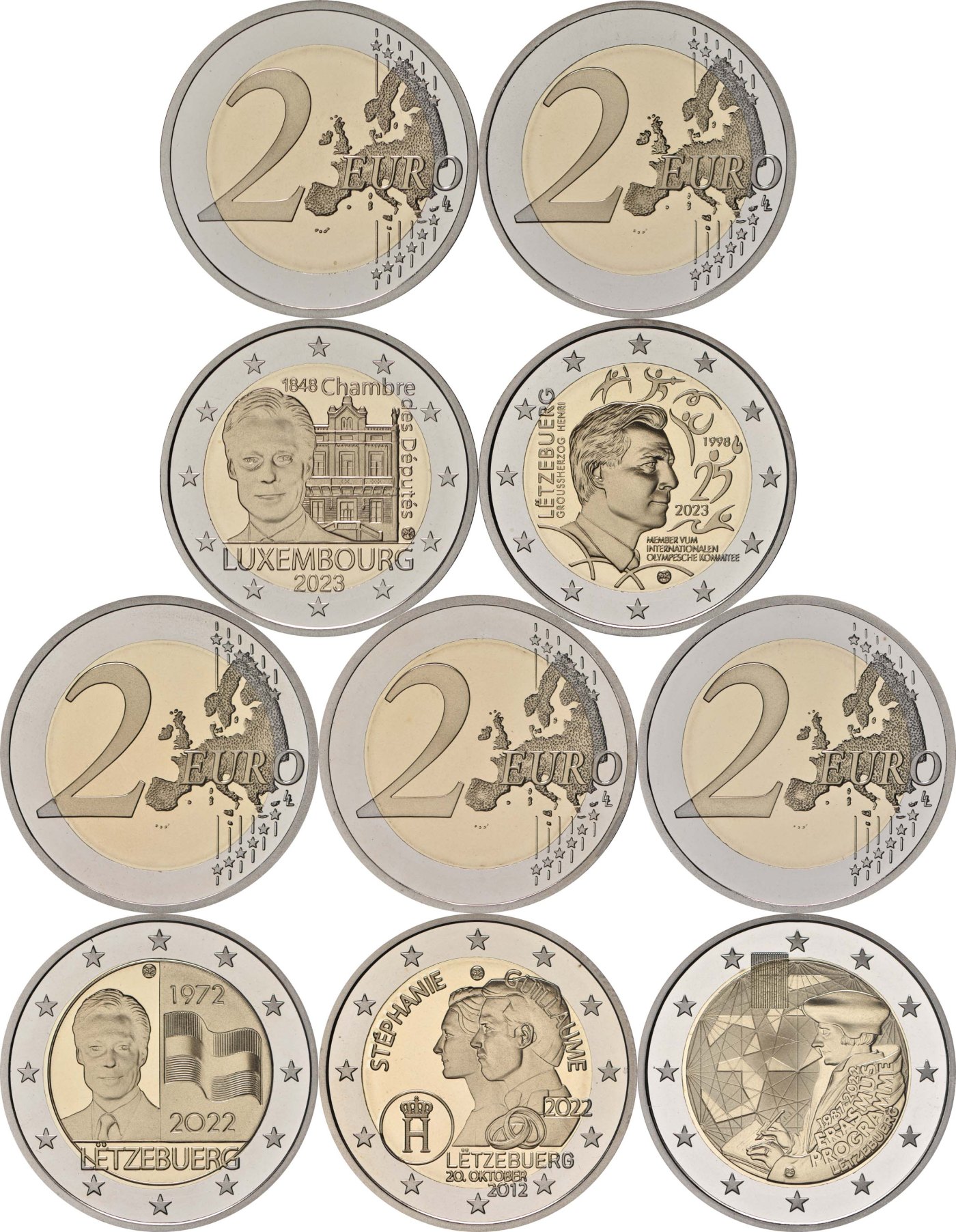
The commemorative coin honours 50 years of legal protection of the Luxembourg flag. The design shows a portrait of Grand Duke Henri on the left and the Luxembourg tricolour on the right, with the year “1972” above and “2022” below. The inscription “LËTZEBUERG” appears below both depictions.
The design
The coin design depicts a portrait of Grand Duke Henri on the left half and the Luxembourg tricolour on the right half. The year “1972” is shown above the flag, while the year of issue “2022” appears below it. Engraved horizontally from left to right beneath both images is the name of the issuing country, “LËTZEBUERG”.
The twelve stars of the European flag are depicted on the outer ring of the coin.
The twelve stars of the European flag are depicted on the outer ring of the coin.
Background on the topic
The Luxembourgish flag consists of three equally wide horizontal stripes in red, white and light blue. Its colours derive from the historic coat of arms of Luxembourg. This depicts a red, crowned lion on a field striped silver and blue. Red, white and blue became established as the national colours in the 19th century, particularly during the Belgian Revolution of 1830, which also spread to Luxembourg.
The tricolour resembles the Dutch flag, but differs from it mainly in its lighter shade of blue. The similarity is not due to direct adoption: Luxembourg’s colours have their own heraldic origin. However, from 1815 to 1890, the Grand Duchy was linked in personal union with the Kingdom of the Netherlands. During this period, the Dutch king was also Grand Duke of Luxembourg.
For a long time, the use of the Luxembourgish national colours was based primarily on custom and historical practice. It was only the Law of 23 June 1972 on the national emblems that legally defined the state symbols and their design. This gave, among other things, the arrangement and colours of the flag a binding legal basis. The coin’s theme therefore refers not to the creation of the tricolour, but to its legal regulation. The year 2022 presented itself as the year of issue because of the round anniversary of this law.
Grand Duke Henri has been the head of state of Luxembourg since 2000. He succeeded his father, Grand Duke Jean, following the latter’s abdication. Luxembourg is a parliamentary monarchy; political decisions are taken by the government and Parliament, while the Grand Duke embodies the continuity of the state and performs constitutional duties. His portrait has regularly appeared on the national sides of Luxembourg’s coins since the introduction of the euro. The association of the head of state with a legally defined national emblem therefore corresponds to the customary depiction of state identity on Luxembourgish coins.
The tricolour resembles the Dutch flag, but differs from it mainly in its lighter shade of blue. The similarity is not due to direct adoption: Luxembourg’s colours have their own heraldic origin. However, from 1815 to 1890, the Grand Duchy was linked in personal union with the Kingdom of the Netherlands. During this period, the Dutch king was also Grand Duke of Luxembourg.
For a long time, the use of the Luxembourgish national colours was based primarily on custom and historical practice. It was only the Law of 23 June 1972 on the national emblems that legally defined the state symbols and their design. This gave, among other things, the arrangement and colours of the flag a binding legal basis. The coin’s theme therefore refers not to the creation of the tricolour, but to its legal regulation. The year 2022 presented itself as the year of issue because of the round anniversary of this law.
Grand Duke Henri has been the head of state of Luxembourg since 2000. He succeeded his father, Grand Duke Jean, following the latter’s abdication. Luxembourg is a parliamentary monarchy; political decisions are taken by the government and Parliament, while the Grand Duke embodies the continuity of the state and performs constitutional duties. His portrait has regularly appeared on the national sides of Luxembourg’s coins since the introduction of the euro. The association of the head of state with a legally defined national emblem therefore corresponds to the customary depiction of state identity on Luxembourgish coins.
eBay price analysis
For this issue, there is a price history based on actual eBay sales – with median, range and number of sales
View price analysis