
 Deutsch
 English
 Français
 Español
 Italiano
 Nederlands
 Português
 Slovenčina
 Hrvatski
 Slovenščina
 Lietuvių
 Eesti
Eesti Български
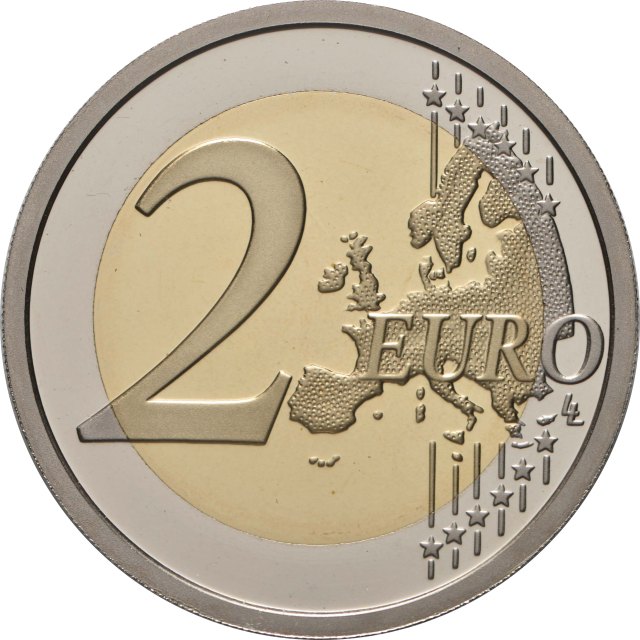
Reverse

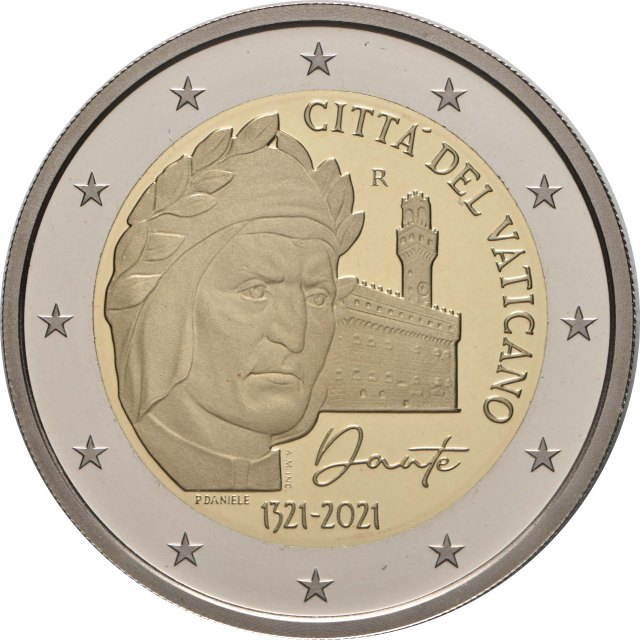
Obverse

More images of the main coin


Vatican · 700th anniversary of the death of Dante Alighieri
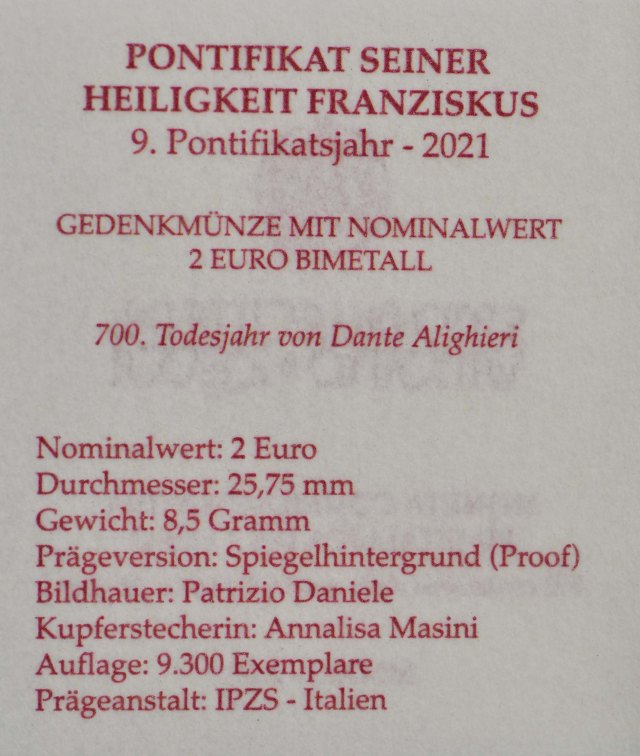
Issue date26 Oct 2021
Total mintage86,300
EU maximum86,000
Editions4
Edge lettering2 ★ × 6, alternately upright/inverted
InscriptionCITTÀ DEL VATICANO / Dante / 1321-2021 / P. DANIELE
DesignerPatrizio Daniele (Annalisa Masini )
mintInstituto Poligrafico e Zecca Dello Stato, Roma
Issue occasion
The commemorative coin marks the 700th anniversary of the death of Dante Alighieri. The design shows a portrait of the poet and the Palazzo Vecchio in Florence; below them are the inscription “Dante” and the years “1321-2021”.
The design
The coin design shows a portrait of Dante Alighieri and the Palazzo Vecchio in Florence. The name of the issuing state, “CITTÀ DEL VATICANO”, is positioned in a semicircle at the top right. At the bottom, the inscription “Dante” and, below it, the years “1321-2021” and the name of the artist, “P. DANIELE”, can be seen. The twelve stars of the European flag are depicted on the coin’s outer ring.
Background on the topic
Dante Alighieri was born in Florence around 1265. Alongside his work as a poet, he participated in the political life of the city-state. At that time, Florence was marked by disputes between rival parties. Dante belonged to the White Guelphs and briefly held the office of prior in 1300, one of the highest municipal government offices. After the opposing Black Guelphs gained power, he was convicted in his absence and banished from Florence. He never returned permanently to his hometown and died in exile in Ravenna.
His best-known work is the poem later called the Divine Comedy (Göttliche Komödie). In it, the narrator travels through the afterlife: Hell, Mount Purgatory, and Paradise. The work combines Christian theology and medieval philosophy with political positions and personal experiences. Dante did not write it in Latin, but in an Italian vernacular based on Tuscan. As a result, his language influenced the later development of literary Italian. His other writings include the “Vita nuova,” which combines poetry and prose about Beatrice, and the political treatise “De monarchia.”
Palazzo Vecchio was built from the late 13th century onward as the seat of the Florentine city government and was initially called Palazzo della Signoria. It thus represents the communal political order in which Dante himself was involved for a time. Its connection with the poet is primarily symbolic: the building embodies Florence as the place of his origin and a political point of reference in his life, although he composed his major work predominantly outside the city.
For the Vatican, a commemoration was also appropriate because of the religious dimension of Dante’s work. His poem about the afterlife addresses guilt, freedom, repentance, justice, and redemption within a Christian worldview, while also containing sharp criticism of the conduct of individual ecclesiastical and secular officeholders. Pope Francis honored Dante in the anniversary year with the Apostolic Letter “Candor lucis aeternae”.
His best-known work is the poem later called the Divine Comedy (Göttliche Komödie). In it, the narrator travels through the afterlife: Hell, Mount Purgatory, and Paradise. The work combines Christian theology and medieval philosophy with political positions and personal experiences. Dante did not write it in Latin, but in an Italian vernacular based on Tuscan. As a result, his language influenced the later development of literary Italian. His other writings include the “Vita nuova,” which combines poetry and prose about Beatrice, and the political treatise “De monarchia.”
Palazzo Vecchio was built from the late 13th century onward as the seat of the Florentine city government and was initially called Palazzo della Signoria. It thus represents the communal political order in which Dante himself was involved for a time. Its connection with the poet is primarily symbolic: the building embodies Florence as the place of his origin and a political point of reference in his life, although he composed his major work predominantly outside the city.
For the Vatican, a commemoration was also appropriate because of the religious dimension of Dante’s work. His poem about the afterlife addresses guilt, freedom, repentance, justice, and redemption within a Christian worldview, while also containing sharp criticism of the conduct of individual ecclesiastical and secular officeholders. Pope Francis honored Dante in the anniversary year with the Apostolic Letter “Candor lucis aeternae”.
eBay price analysis
For this issue, there is a price history based on actual eBay sales – with median, range and number of sales
View price analysisBlister pack BU – Single page
- Packaging
- Blister pack
- Mintage
- 69,000
- Market price
- €37.70
- Edge lettering
- 2 ★ × 6, alternately upright/inverted
Mintage by issue type
BU
74,000
2 Editions
Proof
9,300
Numismatic cover
3,000
More editions
3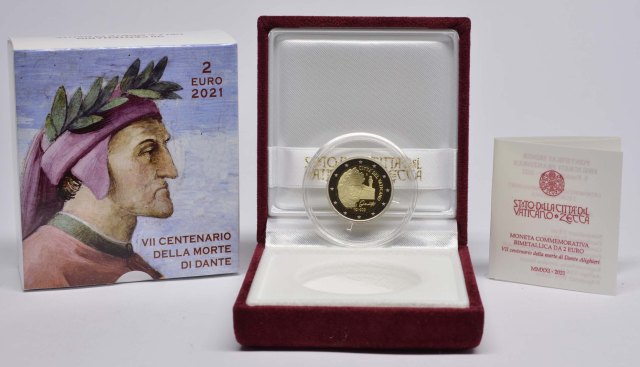
2 euro coinProof
2 Euro Proof
- Mintage
- 9,300
- Market price
- €69.00
- Packaging
eBay price analysis – 2 Euro PP
For this issue, there is a price history based on actual eBay sales – with median, range and number of sales
View price analysis


Issue date
226 Oct 2021 · Vatikan – 700. Todestag von Dante Alighieri
2 Euro Stgl./BU
26 Oct 2021 · Vatikan – 700. Todestag von Dante Alighieri
Blister BU
Mintages
Vatikan
86,300Circulation: 5,000
Proof: 9,300
Blister pack BU: 69,000
Numismatic cover: 3,000
Official issue prices
2021 · Proof: €37.00
2021 · Blister pack BU: €18.00
2021 · Numismatic cover: €46.00