
 Deutsch
 English
 Français
 Español
 Italiano
 Nederlands
 Português
 Slovenčina
 Hrvatski
 Slovenščina
 Lietuvių
 Eesti
Eesti Български
Reverse
Obverse

Estonia · 200th anniversary of the discovery of Antarctica
Issue date27 Jan 2020
Total mintage750,000
EU maximum750,000
Editions2
Edge letteringEESTI × 2, alternating upright/inverted, separated by dots
InscriptionFabian Gottlieb von Bellingshausen / ANTARKTIKA 200 / EESTI / 2020
DesignerTiiu Pirsko, Mati Veermets
mintUAB Lietuvos monetų kalykla, Vilnius (Lithuania)
Issue occasion
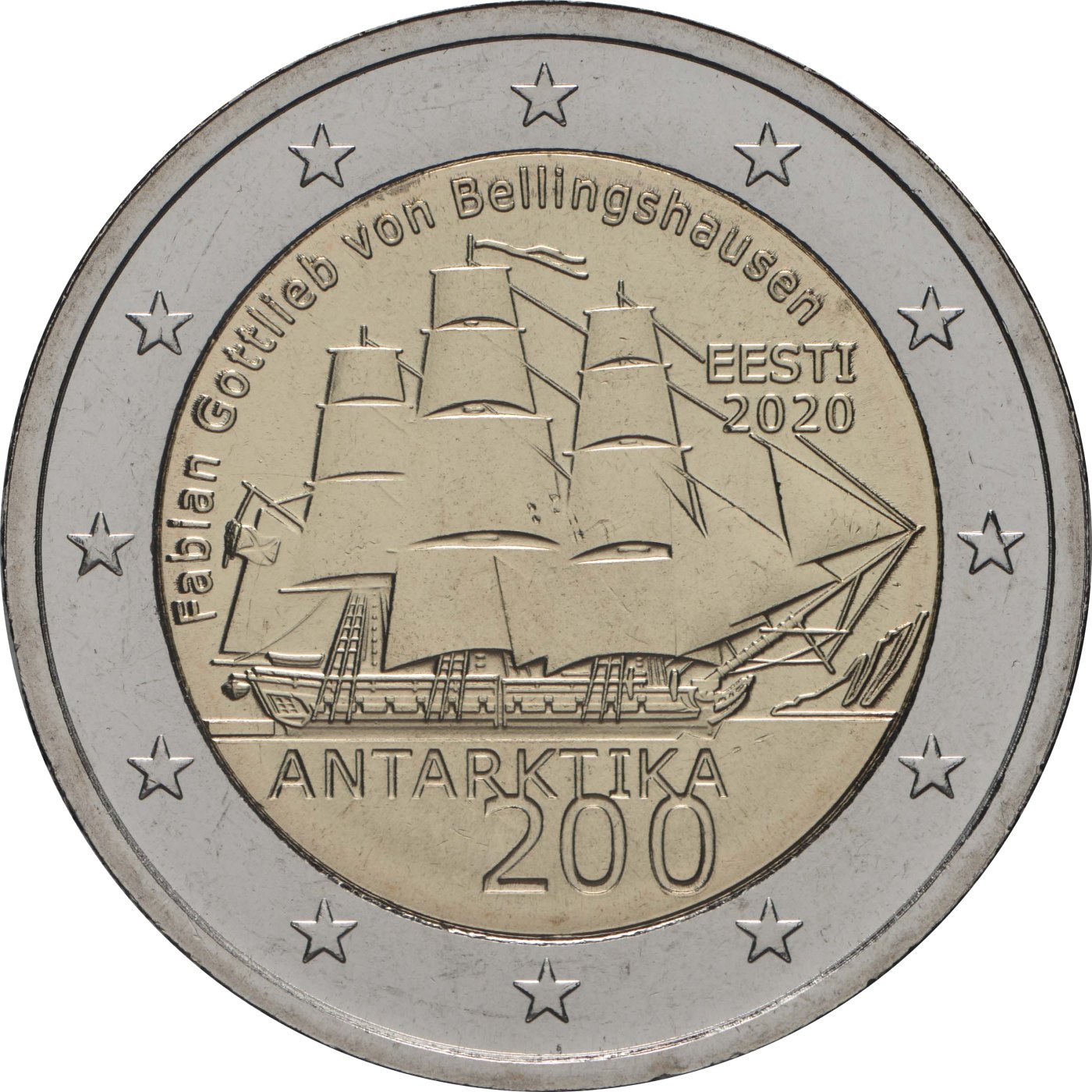
The coin commemorates the 200th anniversary of the discovery of Antarctica. It depicts a sailing ship and the inscriptions “Fabian Gottlieb von Bellingshausen” and “ANTARKTIKA 200”. Bellingshausen was a Baltic German seaman born on Saaremaa who visited Antarctica in 1820 as one of the first people and documented the discovery.
The design
The discovery is associated with Estonia because one of the first men to visit Antarctica in 1820 was Fabian Gottlieb von Bellingshausen, a Baltic-German sailor born in Saaremaa who documented the discovery.
The design depicts a sailing ship. It also bears the inscriptions “Fabian Gottlieb von Bellingshausen” and “ANTARKTIKA 200”, the country name “EESTI” and the year of issue “2020”.
The twelve stars of the European flag are depicted on the outer coin ring.
The design depicts a sailing ship. It also bears the inscriptions “Fabian Gottlieb von Bellingshausen” and “ANTARKTIKA 200”, the country name “EESTI” and the year of issue “2020”.
The twelve stars of the European flag are depicted on the outer coin ring.
Background on the topic
The “discovery” of Antarctica was not a single, undisputed moment. As early as the 1770s, James Cook had crossed the Antarctic Circle, but had been unable to reach the mainland because of the pack ice. It was not until 1820 that several expeditions reported sightings in the vicinity of the Antarctic continent at almost the same time. Alongside the Russian expedition under Bellingshausen, the British naval officer Edward Bransfield and the American sealer Nathaniel Palmer were involved. Whom the first unequivocal sighting should be attributed to also depends on the dating and on whether an observed ice formation was recognized as a mainland coast.
Bellingshausen served in the Imperial Russian Navy. Previously, he had taken part in the first Russian circumnavigation under Adam Johann von Krusenstern, gaining experience in navigation and cartography. The Antarctic expedition of 1819 to 1821 consisted of the ships *Wostok*, commanded by Bellingshausen, and *Mirny*, under Michail Lasarew. Its aim was to explore the southern waters, which were scarcely known at the time.
The ships crossed the Antarctic Circle several times and sailed around Antarctica over long distances. The crews observed an extensive ice barrier off the continent, carried out surveys, and improved the maps of numerous islands and coastal areas. The voyage also included investigations in the South Atlantic and the southern Pacific. The expedition thus made a significant contribution to giving geographical substance to the idea of a large southern continent.
Bellingshausen’s origins point to Estonia’s complex history. The Baltic German population belonged to the society of the Baltic provinces of the Russian Empire at the time; members of this group frequently served in its administration and navy. The anniversary therefore gave Estonia the opportunity to highlight a regionally rooted figure from the international history of exploration and science. The sailing ship also represents the Russian Antarctic expedition and the nautical prerequisites of early Antarctic research.
Bellingshausen served in the Imperial Russian Navy. Previously, he had taken part in the first Russian circumnavigation under Adam Johann von Krusenstern, gaining experience in navigation and cartography. The Antarctic expedition of 1819 to 1821 consisted of the ships *Wostok*, commanded by Bellingshausen, and *Mirny*, under Michail Lasarew. Its aim was to explore the southern waters, which were scarcely known at the time.
The ships crossed the Antarctic Circle several times and sailed around Antarctica over long distances. The crews observed an extensive ice barrier off the continent, carried out surveys, and improved the maps of numerous islands and coastal areas. The voyage also included investigations in the South Atlantic and the southern Pacific. The expedition thus made a significant contribution to giving geographical substance to the idea of a large southern continent.
Bellingshausen’s origins point to Estonia’s complex history. The Baltic German population belonged to the society of the Baltic provinces of the Russian Empire at the time; members of this group frequently served in its administration and navy. The anniversary therefore gave Estonia the opportunity to highlight a regionally rooted figure from the international history of exploration and science. The sailing ship also represents the Russian Antarctic expedition and the nautical prerequisites of early Antarctic research.
eBay price analysis
For this issue, there is a price history based on actual eBay sales – with median, range and number of sales
View price analysis2 Euro BU – Single page
- Mintage
- 740,000
- Market price
- €4.90
- Edge lettering
- EESTI × 2, alternating upright/inverted, separated by dots
Mintage by issue type
BU
740,000
Coincard
10,000
More editions
1

Official issue prices
2020 · Coincard: €10.00