
 Deutsch
 English
 Français
 Español
 Italiano
 Nederlands
 Português
 Slovenčina
 Hrvatski
 Slovenščina
 Lietuvių
 Eesti
Eesti Български


CC 242 2016
2 euro coin
Proof
2 Euro Proof
Italy · 550th anniversary of the death of Donatello
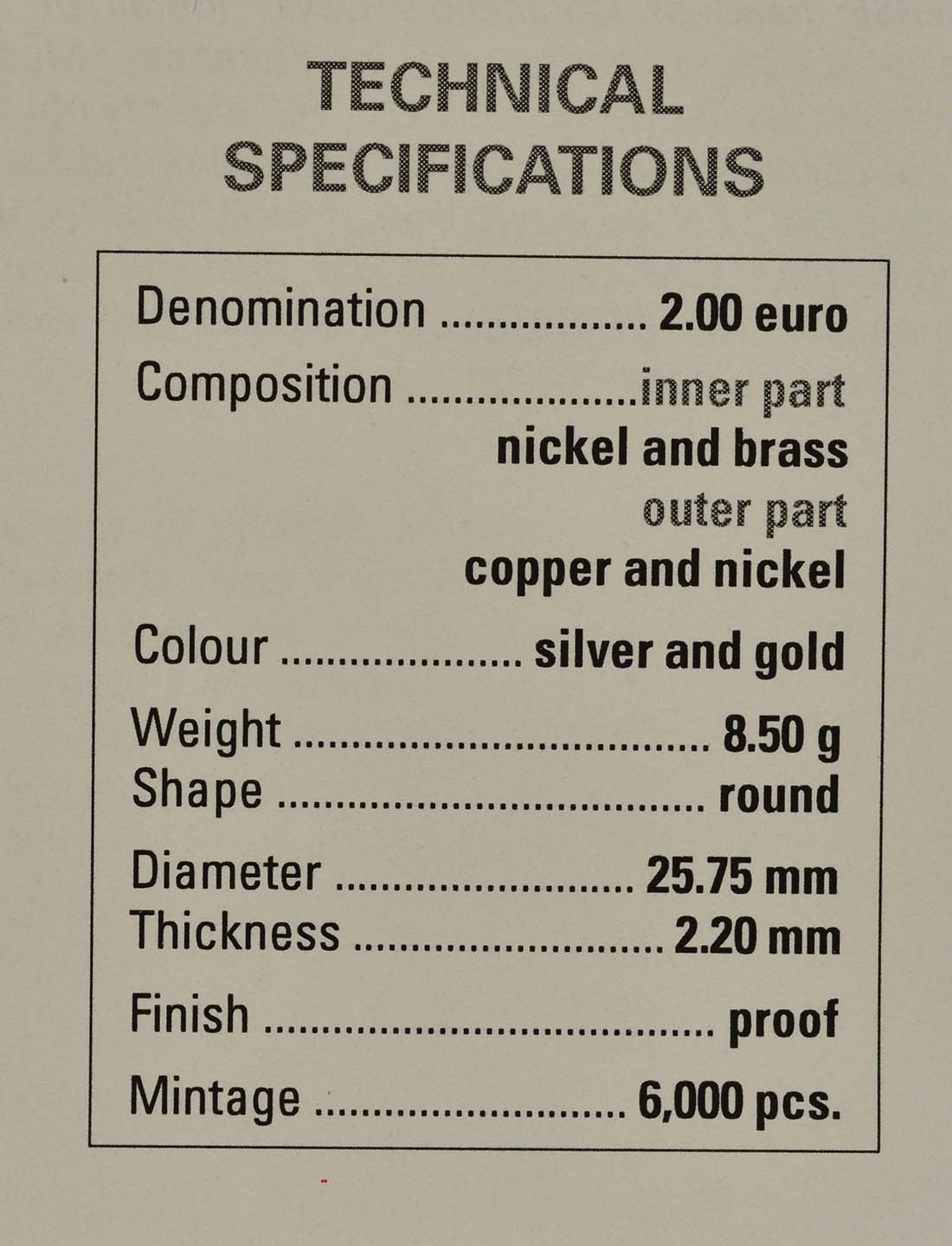
Mintage6,000
Issue price€20.00
Issue date29 Apr 2016
Packagingin case
Edge lettering2 ★ × 6, alternately upright/inverted
Market price€89.00
Issue occasion
The coin commemorates the 550th anniversary of the death of Donatello. The design depicts the head of his David as a detail of the bronze statue exhibited at the Museo Nazionale del Bargello in Florence. The design is completed by the years “1466” and “2016”, the initials “C.M.” of the designer Claudia Momoni, and the inscription “DONATELLO”.
The design
The design shows the head of David by Donatello (detail of the bronze statue displayed in the National Museum of Bargello in Florence). On the left, the abbreviation of the Italian Republic, “RI”, can be seen, with the years “1466” and “2016” below it on two lines. On the right are the initials “C.M.” of the designer Claudia Momoni; the inscription “DONATELLO” runs along the lower edge of the coin.
The outer ring of the coin features the twelve stars of the European flag.
The outer ring of the coin features the twelve stars of the European flag.
Background on the topic
Donatello, actually Donato di Niccolò di Betto Bardi, was born in Florence around 1386. He was one of the sculptors of the Early Renaissance and worked in marble, bronze, wood and terracotta. His training and work took place during a period in which Florence was intensively engaging with the art of Greek and Roman antiquity. Donatello combined its conception of the human body with close observation of posture, movement and individual facial expressions. He also further developed very low relief, which creates spatial depth through slight gradations.
The David depicted is the biblical figure from the First Book of Samuel. The young shepherd defeats the Philistine Goliat, although he is physically superior and heavily armed. Donatello’s figure shows David after the battle: he stands with one foot on Goliat’s severed head and holds his sword. Unlike medieval representations, he appears as a nude, free-standing figure wearing a hat and boots. The exact date of its creation and the original context in which the bronze was displayed have not been conclusively established. It was, however, owned by the Medici and later brought to the Palazzo Vecchio.
The statue refers to ancient nude figures and contrapposto, in which the body weight rests on one leg. At the same time, David is both a Christian hero and a figure open to political interpretation: in Florence, he could be understood as a symbol of a smaller community asserting itself against overwhelmingly powerful opponents. This motif appeared repeatedly in the city’s art.
Donatello’s other works include sculptures for the Florentine Cathedral and Orsanmichele, the equestrian statue of Gattamelata in Padua, and the wooden Mary Magdalene. By choosing a round anniversary of his death and a work closely associated with Florence and the Renaissance, Italy commemorated an artist whose works had a lasting influence on European sculpture.
The David depicted is the biblical figure from the First Book of Samuel. The young shepherd defeats the Philistine Goliat, although he is physically superior and heavily armed. Donatello’s figure shows David after the battle: he stands with one foot on Goliat’s severed head and holds his sword. Unlike medieval representations, he appears as a nude, free-standing figure wearing a hat and boots. The exact date of its creation and the original context in which the bronze was displayed have not been conclusively established. It was, however, owned by the Medici and later brought to the Palazzo Vecchio.
The statue refers to ancient nude figures and contrapposto, in which the body weight rests on one leg. At the same time, David is both a Christian hero and a figure open to political interpretation: in Florence, he could be understood as a symbol of a smaller community asserting itself against overwhelmingly powerful opponents. This motif appeared repeatedly in the city’s art.
Donatello’s other works include sculptures for the Florentine Cathedral and Orsanmichele, the equestrian statue of Gattamelata in Padua, and the wooden Mary Magdalene. By choosing a round anniversary of his death and a work closely associated with Florence and the Renaissance, Italy commemorated an artist whose works had a lasting influence on European sculpture.
eBay price analysis
For this issue, there is a price history based on actual eBay sales – with median, range and number of sales
View price analysis