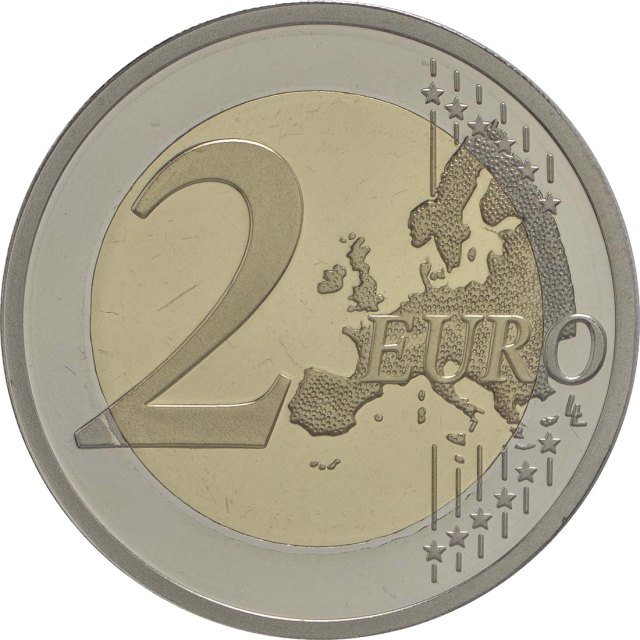
Reverse
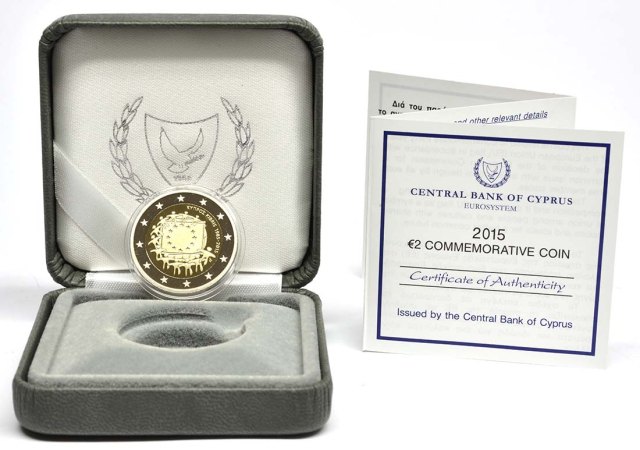
Cyprus 2015 – 30 years of the EU flag · 2 Euro commemorative coin Reverse
Obverse
Cyprus 2015 – 30 years of the EU flag · 2 Euro commemorative coin Obverse
CC 22920152 euro coinBUBank issue

Cyprus · 30 years of the EU flag

Issue date30 Nov 2015
Total mintage350,000
EU maximum350,000
Editions3
Edge lettering2 ΕΥΡΩ 2 EURO × 2
InscriptionΚΥΠΡΟΣ KIBRIS / 1985-2015 / GS
DesignerGeorgios Stamatopoulos
mintBank of Greece - Mint, Halandri

Issue occasion

The coin commemorates the 30th anniversary of the EU flag. The design depicts the flag as a symbol of the connection between peoples and cultures with shared ideas and ideals; its twelve stars take the form of people celebrating the birth of a new Europe. Also shown are the years “1985-2015” and the initials of the designer Georgios Stamatopoulos.

The design
The design depicts the EU flag as a symbol that brings together peoples and cultures with shared ideas and ideals to shape a better future. Twelve stars take the form of people and welcome the birth of a new Europe. At the top right along the coin ring, the issuing country “ΚΥΠΡΟΣ KIBRIS” and the years “1985-2015” can be seen. At the bottom right, the initials of the designer (Georgios Stamatopoulos) are shown.

The outer coin ring depicts the twelve stars of the European flag.
Background on the topic
The European flag, known today as the EU flag, was initially created outside the European Communities. The Council of Europe, an organisation founded in 1949 and independent of the European Union, introduced the emblem in 1955. The circle of twelve golden stars on a blue background was intended to represent the unity of the European peoples. The number twelve did not refer either to the number of Member States at the time or to a desired number of Member States. It was chosen as a fixed symbolic number; therefore, the number of stars does not change with enlargements.

The European Communities initially used their own symbols. In 1983, the European Parliament advocated adopting the European flag for the Communities as well. In June 1985, the Heads of State or Government approved this step. From 1986 onwards, the flag was used by the European institutions. When the European Union was established in 1993, it remained its generally used emblem. At the same time, the Council of Europe continues to use it.

The anniversary therefore referred to the adoption of the already existing European symbol by the European Communities at the time in 1985, not to the original design or its first introduction by the Council of Europe. The commemorative issue gave the countries of the euro area the opportunity to depict this common institutional symbol on coins with a uniform design.

A competition was held among Europe’s mints to create the design. A panel of experts selected five designs, on which citizens and residents of the euro area could vote online. The selected design was subsequently issued by the participating countries as a joint commemorative coin. Such joint issues differ from the usual national €2 commemorative coins: the occasion and the central design motif are the same across countries, while details such as the country name and language are adapted to the respective issuing country. Thus, the form of the issue corresponded to the occasion of a symbol used jointly by the EU countries.

eBay price analysis

For this issue, there is a price history based on actual eBay sales – with median, range and number of sales

View price analysis

2 Euro BU – Single page

Mintage
336,000
Market price
€6.90
Edge lettering
2 ΕΥΡΩ 2 EURO × 2

Mintage by issue type

BU 336,000
Proof 8,000

More editions

2

Mintages

Zypern

350,000
Circulation: 336,000
Proof: 8,000
Other: 6,000

Official issue prices

2015 · Proof: €10.00
2015 · Other: €3.00

Additional information

Zypern: 8.000 PP im Etui, 6.000 BU in Kapsel
Report an error

What's wrong here? Mintage, date, image, attribution – every detail helps.

Will only be stored for the response to this message and used for nothing else.

Share and link

Social / Forum