
 Deutsch
 English
 Français
 Español
 Italiano
 Nederlands
 Português
 Slovenčina
 Hrvatski
 Slovenščina
 Lietuvių
 Eesti
Eesti Български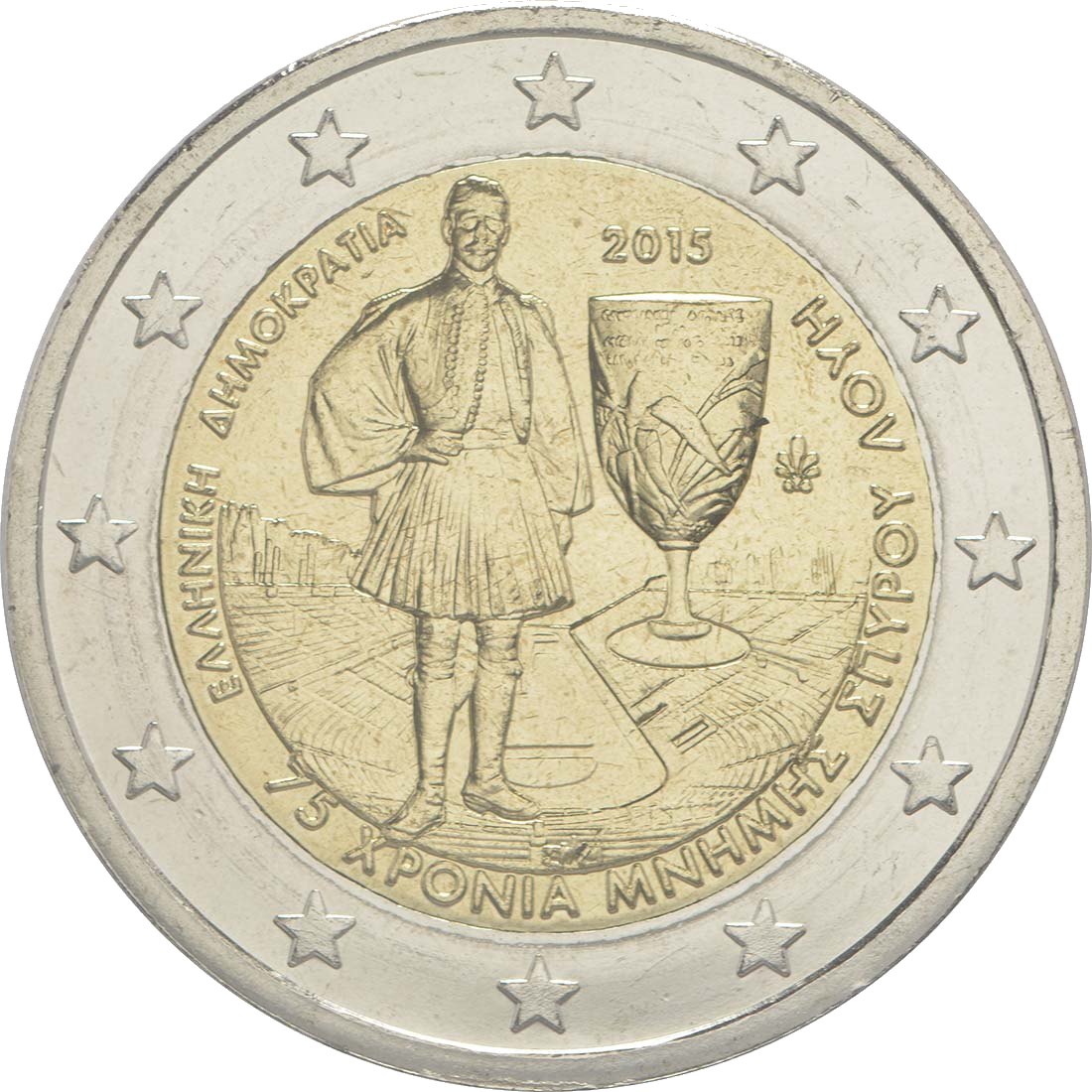

CC 210 2015
2 euro coin
BU Main coin Bank issue
2 Euro BU
Greece · 75th anniversary of the death of Spyros Louis
Mintage741,000
Issue date23 Dec 2015
Edge letteringΕΛΛΗΝΙΚΗ ΔΗΜΟΚΡΑΤΙΑ + ★
Market price€6.56
Issue occasion
The coin commemorates the 75th anniversary of the death of Spyros Louis. The design shows him together with the cup he received, in front of the Panathenaic Stadium (Panathinaiko Stadium). It also features a palmette as the mint mark and the monogram of the artist George Stamatopoulos.
The design
The coin design depicts Spyros Louis and the cup he received, against the background of the Panathinaiko-Stadion. Along the inner edge, the issuing country “HELLENIC REPUBLIC” and “75 YEARS IN MEMORY OF SPYROS LOUIS” (in Greek) can be read. Above the cup is the year of issue “2015”; to its right, a palmette, the mint mark of the Greek mint, is engraved. The artist’s monogram (George Stamatopoulos) is located at the bottom edge of the coin design.
The twelve stars of the European flag are depicted on the coin’s outer ring.
The twelve stars of the European flag are depicted on the coin’s outer ring.
Background on the topic
Spyridon “Spyros” Louis was a Greek runner from Marousi near Athen. He became known for his victory in the marathon race at the first Olympic Games of the modern era in 1896 in Athen. Before that, he had not attracted attention as an international competitive athlete. His success made him a national symbol in Griechenland. After the Games, he largely withdrew from sport and led a life that attracted little public attention. He died in 1940.
The marathon race had been specifically added to the programme of the 1896 Games. The idea originated with the French linguist Michel Bréal. It was based on the tradition of an ancient messenger who was said to have brought the news of the Greek victory to Athen after the Battle of Marathon. In 1896, the course ran from Marathon to Athen and was approximately 40 kilometres long, shorter than the marathon distance of 42.195 kilometres established later. Louis reached the finish first, thereby achieving the only Greek victory in a running event at these Games.
The silver cup known as the “Bréal-Pokal” had been donated by Michel Bréal for the winner of the marathon race. Its design refers to the ancient landscape of Marathon through plant motifs and a Greek inscription. The cup remained in the possession of Louis’s family for a long time and was later acquired by a Greek cultural foundation.
The Panathinaiko-Stadion stands on the site of an ancient Athenian stadium. It was renovated in the 19th century for the revival of athletic competitions and completely rebuilt in marble for the Olympic Games of 1896. Among other events, the marathon finish and the closing ceremony took place there.
The choice of the occasion therefore links a specific Greek athlete’s biography with the re-establishment of the Olympic Games. Louis’s finish also became part of the Greek remembrance of the 1896 Games in Athen and of the connection between modern sporting events and ancient traditions.
The marathon race had been specifically added to the programme of the 1896 Games. The idea originated with the French linguist Michel Bréal. It was based on the tradition of an ancient messenger who was said to have brought the news of the Greek victory to Athen after the Battle of Marathon. In 1896, the course ran from Marathon to Athen and was approximately 40 kilometres long, shorter than the marathon distance of 42.195 kilometres established later. Louis reached the finish first, thereby achieving the only Greek victory in a running event at these Games.
The silver cup known as the “Bréal-Pokal” had been donated by Michel Bréal for the winner of the marathon race. Its design refers to the ancient landscape of Marathon through plant motifs and a Greek inscription. The cup remained in the possession of Louis’s family for a long time and was later acquired by a Greek cultural foundation.
The Panathinaiko-Stadion stands on the site of an ancient Athenian stadium. It was renovated in the 19th century for the revival of athletic competitions and completely rebuilt in marble for the Olympic Games of 1896. Among other events, the marathon finish and the closing ceremony took place there.
The choice of the occasion therefore links a specific Greek athlete’s biography with the re-establishment of the Olympic Games. Louis’s finish also became part of the Greek remembrance of the 1896 Games in Athen and of the connection between modern sporting events and ancient traditions.
eBay price analysis
For this issue, there is a price history based on actual eBay sales – with median, range and number of sales
View price analysis