
 Deutsch
 English
 Français
 Español
 Italiano
 Nederlands
 Português
 Slovenčina
 Hrvatski
 Slovenščina
 Lietuvių
 Eesti
Eesti Български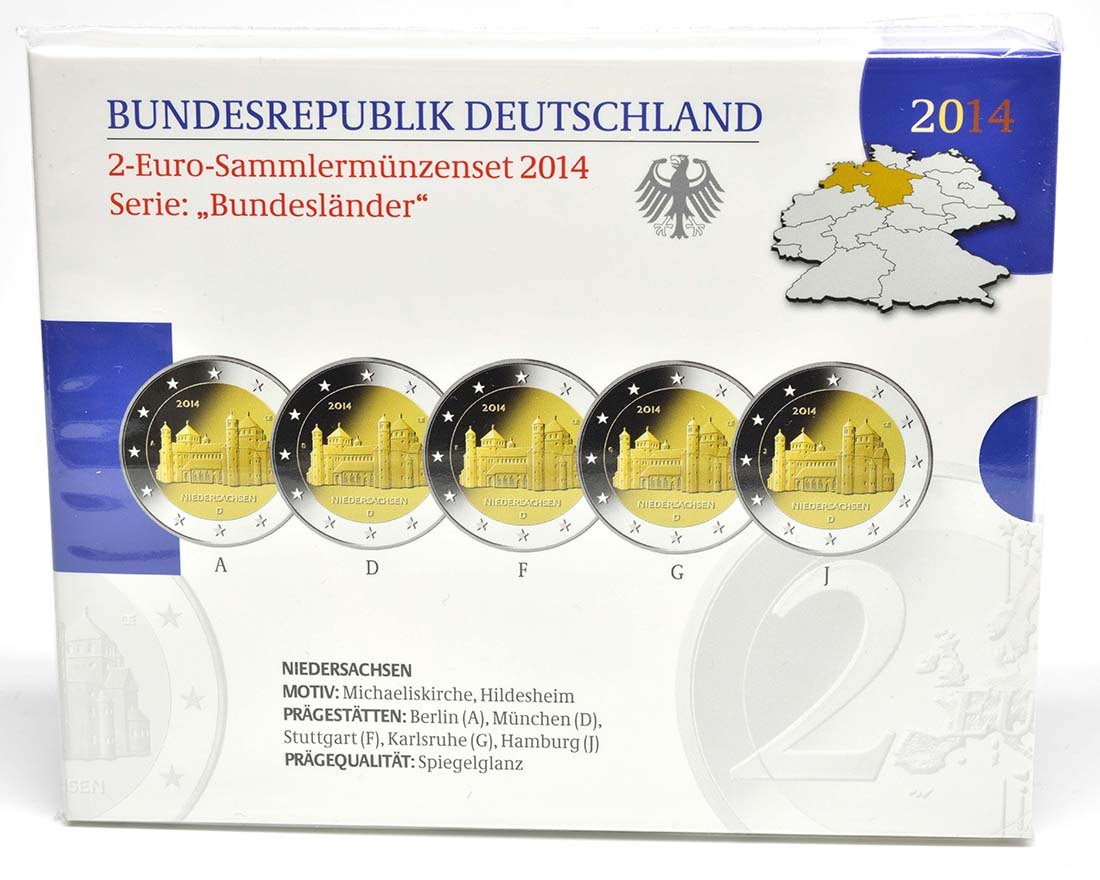
CC 159 2014
Blister pack
Proof
Proof blister
Germany · Lower Saxony, St. Michaeliskirche zu Hildesheim
Mintage50,000
Issue price€32.25
Issue date7 Feb 2014
PackagingBlister pack
Edge letteringEINIGKEIT UND RECHT UND FREIHEIT + Federal Eagle
Market price€32.00
Varieties
1Germany, A · A · Mint mark A · Proof · Blister pack · Mintage 50,000
Issue occasion
The commemorative coin is dedicated to Niedersachsen as part of the “Federal States Series”. The design shows the southeast view of the Michaeliskirche in Hildesheim, which has been a UNESCO World Heritage Site since 1985. It also features the inscription “NIEDERSACHSEN” and the initials of the designer Erich Ott.
The design
South-eastern view of the Michaeliskirche in Hildesheim (Niedersachsen), which has been part of UNESCO’s World Heritage List since 1985. Above the coin design, the issue year “2014” is shown; on the left side, the mint mark (A, D, F, G or J) can be seen. In the lower part, the word “NIEDERSACHSEN” and, below it, a “D” for the issuing state are engraved. The initials of the designer Erich Ott (OE) appear in the upper right.
The twelve stars of the European flag are depicted on the coin’s outer ring.
The twelve stars of the European flag are depicted on the coin’s outer ring.
Background on the topic
Michaeliskirche was built at the beginning of the 11th century as the church of a Benedictine monastery. Its construction was commissioned by Bernward, the Bishop of Hildesheim. Bernward belonged to the circle of the Ottonian rulers and served for a time as tutor and adviser to Emperor Otto III. In Hildesheim, he promoted architecture, metalwork and book illumination. After his death in 1022, he was buried in the church’s crypt.
The building follows a strictly structured, symmetrical ground plan with two choirs, two transepts and several towers. Characteristic is the alternation of piers and columns in the nave, known as the “Lower Saxon alternation of supports”. The complex illustrates church architecture of the Ottonian period and influenced later Romanesque buildings. The interior contains a painted wooden ceiling from the 13th century. It depicts the genealogy of Christ and is one of the few surviving monumental wooden ceilings from the Middle Ages.
With the Reformation, the church became Protestant Lutheran, while the monastery initially continued to exist. The building was severely damaged in an air raid on Hildesheim in March 1945. The reconstruction consciously followed the medieval form and was completed by 1960. Previously relocated structural elements and works of art were also reused.
The German federal states series presented the federal states in the order of their presidencies of the Bundesrat. Niedersachsen held the presidency in 2013 and 2014 and was therefore featured in 2014. For each federal state, a building or landmark was selected to represent its history and cultural heritage. In this context, Michaeliskirche refers both to medieval Hildesheim as a religious and artistic centre and to the treatment of war-damaged cultural heritage in the 20th century.
The building follows a strictly structured, symmetrical ground plan with two choirs, two transepts and several towers. Characteristic is the alternation of piers and columns in the nave, known as the “Lower Saxon alternation of supports”. The complex illustrates church architecture of the Ottonian period and influenced later Romanesque buildings. The interior contains a painted wooden ceiling from the 13th century. It depicts the genealogy of Christ and is one of the few surviving monumental wooden ceilings from the Middle Ages.
With the Reformation, the church became Protestant Lutheran, while the monastery initially continued to exist. The building was severely damaged in an air raid on Hildesheim in March 1945. The reconstruction consciously followed the medieval form and was completed by 1960. Previously relocated structural elements and works of art were also reused.
The German federal states series presented the federal states in the order of their presidencies of the Bundesrat. Niedersachsen held the presidency in 2013 and 2014 and was therefore featured in 2014. For each federal state, a building or landmark was selected to represent its history and cultural heritage. In this context, Michaeliskirche refers both to medieval Hildesheim as a religious and artistic centre and to the treatment of war-damaged cultural heritage in the 20th century.